A timeout can create a duplicate trade
If an order request times out, blindly retrying can duplicate the position — the broker may have received the first request.
Algo Trade automates configurable intraday options strategies, monitors positions in real time, triggers rule-based adjustments, and executes across multiple broker accounts from a unified control interface.
Options execution.
Multi-account replication.

Strategies, open positions, account and combined P&L, and available margin in a single interface.
Follow the workflow ↗Algorithmic options trading
Execution & multi-broker platform
Trading workflow design to execution engineering
Options strategies such as straddles and strangles can require additional trades when individual positions reach predefined profit or loss thresholds. The challenge was never simply placing orders automatically.
The system continuously evaluates every active position to determine whether an adjustment threshold has been reached, which position should receive the counter trade, how large it should be, which strike to select, whether capital is available, and how the adjustment affects all connected accounts.
That logic has to run continuously against live market data — and a single trading decision may become multiple broker orders.
If an order request times out, blindly retrying can duplicate the position — the broker may have received the first request.
Accounts differ by broker, quantity multiplier, available capital, authentication session, API rate limit and execution state.
As adjustment positions accumulate, the next trade may need more capital than the account has — the platform decides that explicitly rather than letting broker rejection define strategy behaviour.
Five views of the delivered platform.
Each shows another part of the execution path.
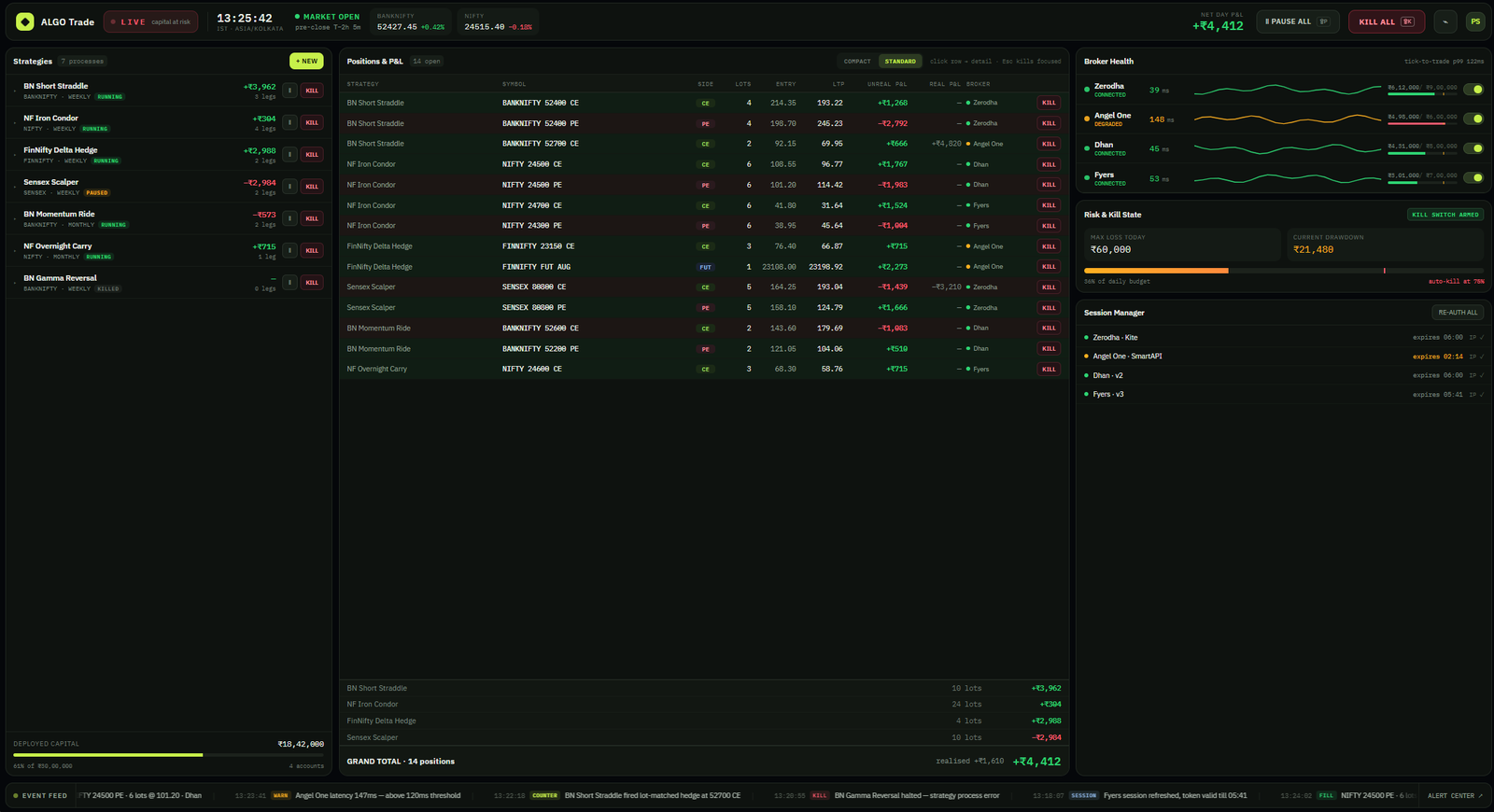
Strategies, open positions, account-level and combined P&L, and available margin sit together, so the operator sees state rather than assembling it.
Market data→Evaluate→Adjust→Size→Replicate→Submit→Reconcile
Order lifecycle and reconciliation were treated as core architecture problems rather than simple API handling. If the application restarts with open positions, relying entirely on local database records can resume the engine from an incorrect state.
The platform was designed around a sub-150 ms tick-to-trade target under normal market conditions. Broker infrastructure and exchange processing contribute significantly to total latency, so the architecture focused on minimising the part it controls: the path between receiving market data and submitting an order.
Look under the hood ↘Every active position is continuously assessed against its configured adjustment thresholds.
The fill is recorded against the account and the position becomes part of the next evaluation cycle.
An uncertain broker response is resolved before any retry, because a blind retry can create a duplicate trade.
One decision becomes the correct order for each account's broker, multiplier and available capital.
Order state is reconciled against the broker rather than assumed from local records, so a restart resumes from reality.
The stack was chosen around the part of execution the platform can actually control — evaluating market data and submitting an order — with broker differences absorbed behind a common abstraction.

The trading dashboard: strategies, positions, per-account and combined P&L, and available margin.
An operator managing multiple accounts needs one place to see state and intervene, not one tab per broker.

Carries strategy evaluation, adjustment logic, sizing and the order submission path.
Adjustment decisions depend on live position state; splitting the evaluation from the execution adds a hop the latency budget cannot afford.

Holds strategies, accounts, positions and the order lifecycle record that reconciliation depends on.
After a restart, local state alone can be wrong — the record exists so it can be checked against the broker.

Holds fast-moving state on the path between market data and order submission.
The tick-to-trade path cannot wait on durable writes for data that changes every tick.

Broker API abstraction layers over Zerodha Kite Connect and Dhan SmartConnect, each with its own session and rate limits.
Accounts differ by broker, and a strategy should express intent once rather than per-integration.
Drives the continuous evaluation cycles that keep adjustment logic running against live market data.
Adjustment thresholds are only meaningful if every active position is checked continuously, not on user action.
The architecture and product narrative reproduce the supplied project documentation. Interface values are product screen data and are not presented as investment results or evidence of future performance.
Technology names identify the documented implementation, not partnerships or endorsements.
Bring one execution, adjustment or reconciliation workflow. In 30 minutes, we will map where automation is safe, and where an operator still has to decide.
30 minutes · Your strategy, brokers and constraints