A valid signal can still be a bad order
Loss limits, correlation, spread, news, portfolio heat, and existing exposure all affect whether execution is appropriate.
Cadence turns trading signals into risk-controlled, auditable broker executions—connecting one strategy core to pre-trade gates, position sizing, order safety, lifecycle management, reconciliation, research, and real-time operational oversight.
Algorithmic trading.
Operational control.

Operators can see what is trading, what is blocked, what the broker reports, and what needs intervention.
Inspect the controls ↗Algorithmic trading operations
Execution + risk platform
Product, quant & full-stack engineering
Production trading is not only signal generation. Every decision must account for portfolio exposure, loss limits, execution costs, broker state, network uncertainty, position management, and the integrity of future strategy changes.
Cadence was engineered around two questions: before a trade, should the system be allowed to place it? After a trade, what happened—and does the platform’s state agree with the broker?
The platform operated against OANDA’s brokerage environment and processed more than 500 trades through execution, management, and reconciliation workflows.
Loss limits, correlation, spread, news, portfolio heat, and existing exposure all affect whether execution is appropriate.
The broker may accept an order even when the platform never receives the response, making blind retry unsafe.
Separate strategy implementations make historical results describe software that is no longer actually trading.
Explore the supplied interfaces for command oversight, risk enforcement, trading history, and system-state auditability.
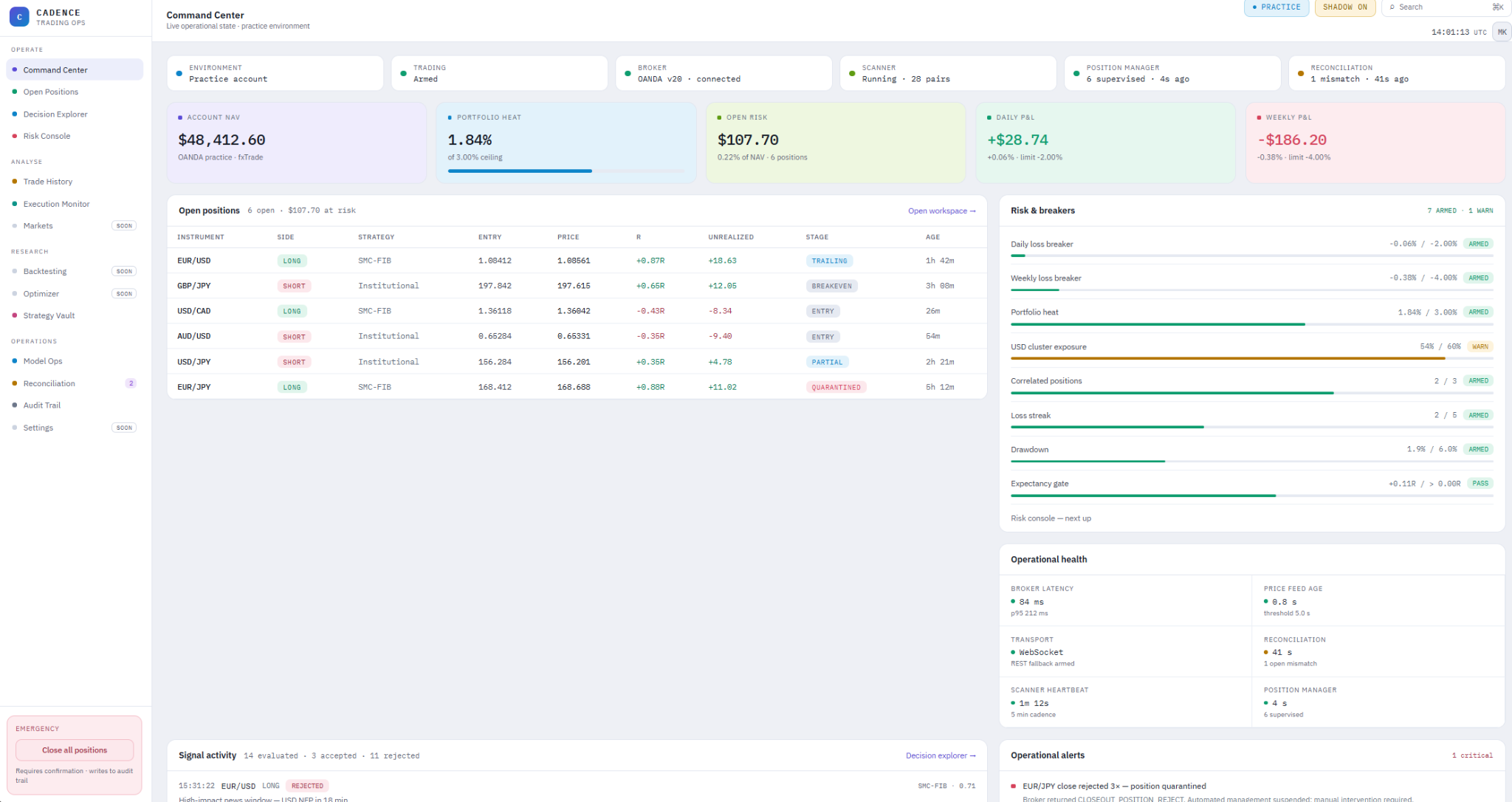
Positions, exposure, breakers, reconciliation, data freshness, signal decisions, and alerts remain visible in one operational workspace.
Signal→Strategy→Rules→Risk gates→Size→Execute→Manage→Reconcile
TradingView webhooks and the autonomous scanner converge on the same strategy and risk pipeline. No order-producing path bypasses shadow mode, position limits, idempotency, execution validation, or slippage protection.
Look under the hood ↘24 layered pre-trade checks across rules, portfolio gates, and execution economics
Allocation, streak, drawdown, session, and optional Kelly adjustments remain below absolute caps.
Record the check, threshold, measured value, outcome, and evaluation duration.
Use a unique client identifier and resolve uncertain broker state before any retry.
Combine the transaction stream with independent polling and idempotent persistence.
If critical balance, exposure, or gate inputs cannot be trusted, trading is blocked.
If ML or sentiment becomes unavailable, it degrades to a neutral state instead of destabilizing execution.
Research may recommend a configuration; it cannot silently replace live strategy parameters.
The architecture keeps research and live logic congruent, centralizes order authorization, treats the broker as the source of truth, and separates optional intelligence from the safety-critical execution path.

A browser-based command surface brings live positions, risk, research, execution, reconciliation, and audit into one product.
Real-time transport and tiered refresh patterns keep fast-changing state visible without turning every view into a polling storm.

Strategy functions, risk services, execution, reconciliation, research, and APIs share a typed Python foundation.
The same pure signal logic can run in historical simulation and live scanning, reducing research-to-production drift.
REST execution, pricing, account data, and transaction streaming connect the platform to broker-side reality.
A live event stream minimizes latency while 60-second polling independently protects correctness after missed events.

Trades, signals, decisions, settings, versions, and audits stay distinct from experimental research records.
Optimizer and backtest activity cannot contaminate production trading statistics or operational state.

Regime, anomaly, exit, and sentiment services add context while remaining outside the core reliability path.
A more sophisticated model is promoted only when it demonstrates improvement against the established baseline.

Automated delivery, health verification, restart drills, and regression coverage support operational reliability.
Financial controls matter most during restarts, timeouts, and degraded dependencies—not only on the happy path.
External alerts and five-minute internal scans converge.
The same functions support backtest and live scanning.
Rules, risk gates, execution costs, then dynamic sizing.
Shadow control, idempotency, limits, and slippage bounds.
Bracket orders, pricing, account data, and transaction events.
Breakeven, partial profit, trailing behavior, time stops, and news protection.
Resumable stream, gap replay, independent polling, and idempotent updates.
The architecture and product narrative reproduce the supplied project documentation. Interface values are product screen data and are not presented as investment results or evidence of future performance.
The delivered platform spans live operations, quantitative research, broker integration, machine learning, reporting, security, and cloud delivery.
130+ REST routes · 31 dashboard panels · 24 layered pre-trade checks · 13 background services · 500+ trades processed · 115+ automated tests · more than three months against live market data
Cadence was engineered to make a deployed strategy operate through controlled, observable, testable, and auditable infrastructure. This case study does not claim or guarantee trading profitability, investment performance, or future results.
Technology and platform names identify the documented implementation, not partnerships or endorsements.
Bring one execution, risk, reconciliation, research, or trading-operations workflow. In 30 minutes, we’ll map the failure modes, control points, and a practical engineering next step.
30 minutes · Your system, controls, and next step
30 minutes · Your system, controls, and next step