Three media types, one citation experience
A text citation is a snippet and a page reference. An audio citation is a moment in a waveform. A video citation is a time range inside a file that may be hours long.
Compass gives employees one governed interface for asking questions across approved company content — documents, recordings and training videos — and opens the cited source at the exact moment the answer came from.
Managed RAG on Amazon Q Business.
Timestamp-aware citations.

A document page, an audio moment and a video segment — cited side by side under the same answer.
Follow the citation ↗Enterprise knowledge management
Custom chat experience on managed RAG
Architecture to identity & DevOps
Internal knowledge lives in three places at once: document repositories, recorded meetings, and training video libraries. Finding one specific fact means opening folders, skimming PDFs, and scrubbing through recordings by hand.
The problem is worst for multimedia. A policy detail explained at minute 47 of an enablement call is effectively unfindable. Employees either re-watch the recording, ask a colleague, or act on memory.
Every architectural decision in Compass — source attribution mapping, access revalidation on citation click, timestamp seeking — exists to make answers checkable.
A text citation is a snippet and a page reference. An audio citation is a moment in a waveform. A video citation is a time range inside a file that may be hours long.
Running every video through a custom transcription pipeline doubles processing cost and creates a second source of truth that drifts from the first.
A custom application must not hand the browser AWS credentials or believe what it claims about who the user is — document permissions depend on it.
Four views of the delivered platform.
Each shows another part of how an answer becomes checkable.
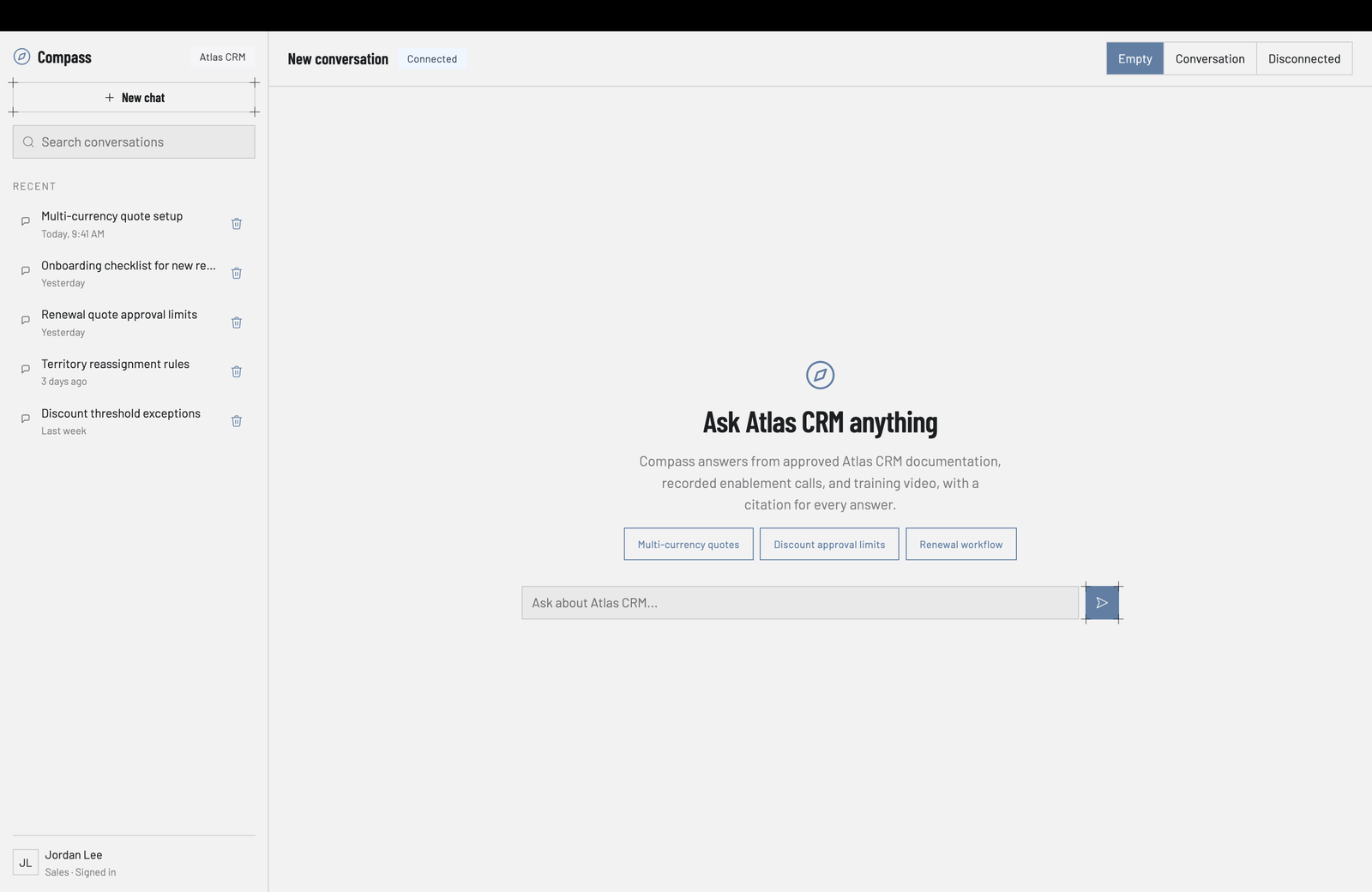
PDFs, Office documents, text files, scanned content, audio and video all flow through one S3 bucket and one connector — with suggested starting questions for every answer.
Sync content→Authenticate→Ask→Stream answer→Attach citations→Open the source
Every call — chat, history, deletion, citation access — runs under the verified employee's identity so Amazon Q Business can enforce document ACLs per user. There is no code path where a browser-supplied user ID becomes authorization evidence.
A citation link is never a bearer of authority: opening one revalidates the session and source access before any media URL is returned.
Look under the hood ↘The connection Lambda validates the session token and derives the immutable user and group context.
Document citations show the source title, a quoted snippet and a page reference, backed by a protected link.
Video and audio citations carry the returned start and end timestamps, so the player opens at the cited moment.
Amazon Q Business applies the user's identity, group membership and indexed source ACLs to every retrieval.
The citation resolver re-checks session and source access, then returns a short-lived URL with start and end seconds.
Compass deliberately does not build an application-managed vector database, a duplicate transcription pipeline, or a parallel conversation store. Amazon Q Business remains the system of record; Compass adds the experience, the transport, the identity boundary and the citation navigation.

System of record for knowledge, conversations, messages and source attributions, with native multimedia extraction.
No second index to operate, and no transcription pipeline that can drift out of sync with the first.

A private, KMS-encrypted, versioned bucket holds all approved content, crawled on an incremental synchronization schedule.
Multimedia takes longer to process than text; re-crawling everything on every run would be slow and expensive.
Four single-purpose functions behind the WebSocket API: connection and auth, streaming chat, conversations, and the citation resolver.
Least-privilege permissions per function — clearer security boundaries and smaller failure domains than one monolithic backend.
Carries all chat, conversation and citation actions, relaying ordered response deltas as the answer is generated.
Employees read the answer while it is being written, with a stop control available mid-stream.

Employees authenticate through the organization's identity provider; the trusted backend establishes identity-aware credentials per user.
The browser never receives AWS credentials, and its own claims are never treated as authorization.

Holds short-lived WebSocket connection context only, expiring on its own through TTL.
Q Business already stores conversations and messages, so a parallel conversation store would be a second thing to keep correct.
The architecture and product narrative reproduce the supplied project documentation. Interface values are product screen data.
Technology names identify the documented implementation, not partnerships or endorsements.
Bring one internal knowledge workflow — documents, recordings, training content, or all three. In 30 minutes, we will map where retrieval, permissions and verification have to meet.
30 minutes · Your content, permissions and constraints