Professional traders need order-book tools
Limit orders, market orders, depth, charts, trade history, open orders, portfolio accounting, and execution rules.

Meridian is a hybrid DEX trading platform that gives traders a professional CEX-style terminal while keeping deposits, withdrawals, vault custody, and settlement verification anchored to blockchain infrastructure.
Hybrid order book.
Multi-chain custody.

Trades match off-chain; deposits, withdrawals, custody, and settlement run through verifiable controls.
Open the terminal ↗Web3 / DeFi trading
Hybrid DEX platform
Product, backend, smart contracts & DevOps
Token ecosystems need liquidity venues with familiar execution, predictable depth, and professional controls—but users still expect wallet-native access and transparent custody.
Meridian bridges that gap by separating high-frequency trade matching from blockchain custody and settlement verification.
The result is not a swap UI. It is exchange infrastructure: accounting, matching, risk, reconciliation, market data, administration, and smart contracts working as one system.
Limit orders, market orders, depth, charts, trade history, open orders, portfolio accounting, and execution rules.
Deposits, withdrawals, locks, fills, and settlement require transactional and chain-verifiable controls.
Network lag, withdrawal queues, reconciliation gaps, market-maker activity, and vault TVL must be surfaced.
The interface covers the full venue lifecycle: connect wallet, deposit assets, trade through a central limit order book, inspect portfolio state, monitor leaderboards, and run operations through admin controls.
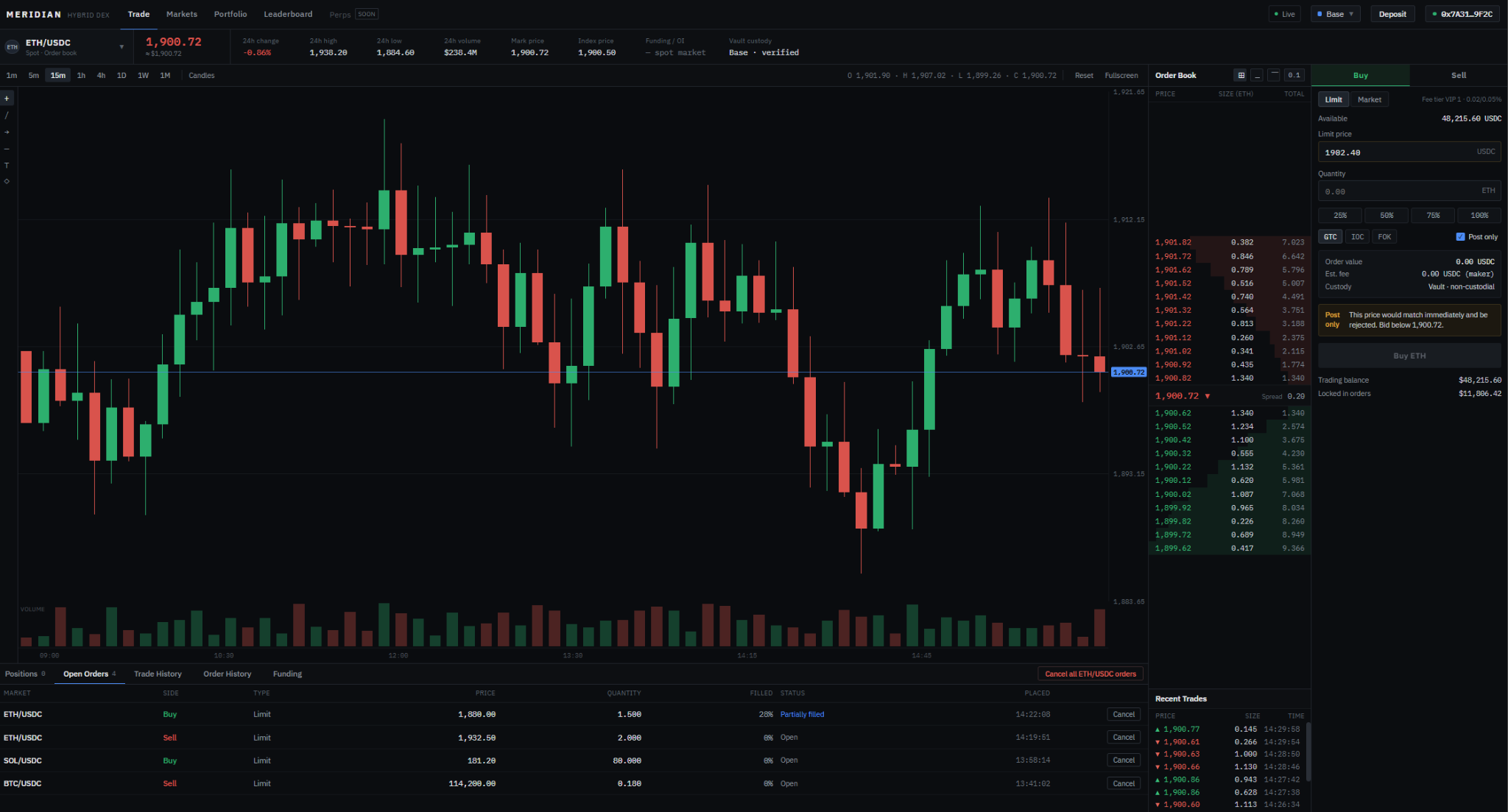
The trading screen gives users order-book depth, candles, limit and market order controls, open orders, live trades, and verified vault custody status.
Wallet sign-in→Verify deposit→Lock funds→Match order→Persist fills→Broadcast updates→Settle
Putting every order-book action on-chain would make the trading experience slow and expensive. Meridian uses deterministic off-chain matching for execution, while smart-contract vaults and settlement contracts preserve custody and verification boundaries.
Look under the hood ↘EIP-712 challenges verify the trader’s wallet without email/password account creation.
Price-time priority, fixed-point arithmetic, in-memory order books, and API-compatible failover.
Multi-chain deposits, withdrawals, settlement anchoring, pausing, roles, and upgrade procedures.
The backend independently fetches blockchain receipts and decodes vault events before balances change.
Funds are reserved transactionally before any outbound chain action begins.
Execution stays fast; custody stays verifiable; operations stay inspectable.
The platform was designed around receipt verification, atomic balance locking, withdrawal safeguards, reconciliation, audit logs, and role-controlled operations.
The stack separates frontend trading experience, API orchestration, deterministic matching, transactional accounting, real-time state, and smart-contract custody so each failure mode can be contained.

Maintains the central limit order book with fixed-point arithmetic and strict price-time priority.
Matching needs deterministic behavior, predictable performance, and tight control over numeric correctness.

Vault, settlement, withdrawal, role, pause, and upgrade infrastructure across supported networks.
Exchange infrastructure evolves, but upgrades must preserve state and follow controlled procedures.

Stores balances, locks, orders, fills, withdrawals, deposits, audit trails, and reconciliation state.
Funds, orders, and settlements need transactional integrity rather than eventually consistent guesses.

Delivers authenticated APIs, account updates, live trades, order-book state, and operational feeds.
Trading interfaces depend on immediate account, order, and market state changes.

Supports hot market data, service coordination, failover state, and high-frequency operational paths.
Fast views can be cached, but money-moving truth remains in transactional systems and chain receipts.

Handles wallet connections, typed signing, approvals, contract interactions, and multi-chain UX.
Traders keep Web3 onboarding while receiving an exchange-style product experience.
Short-lived EIP-712 nonce proves wallet control before the app session starts.
Receipts and vault events are independently verified before crediting balances.
Atomic database updates prevent double spending across concurrent orders.
The Rust engine applies price-time priority and fixed-point math.
Fills, balances, withdrawals, and settlement batches remain auditable.
The supplied screens show trading, portfolio, leaderboard, admin operations, and security/account controls. Live market values shown are demo data and should not be treated as investment information.
This case study describes platform engineering and demo interfaces, not financial advice or a live exchange offer. Production operation requires jurisdiction-specific legal, compliance, custody, security, and market-surveillance review.
Technology names identify the documented implementation, not partnerships or endorsements.
Hybrid exchanges fail when they treat deposits, withdrawals, and matching recovery as edge cases. Meridian makes those paths first-class: verify-first deposit crediting, debit-first withdrawal submission, deterministic matching, reconciliation, and auditable admin intervention.
The product is engineered for the practical reality of trading infrastructure: latency matters, but recoverability and accounting integrity matter more.
Order book · price-time priority · fixed-point math
Vaults · chain receipts · settlement anchoring
Locked balances · safeguards · derivatives-ready controls
Network lag · withdrawal queue · audit log
Deposits require blockchain receipt and vault-event verification before balances update.
Withdrawal intent starts with a transactional debit or lock before chain submission.
Engine recovery preserves resting orders, priority, fills, and reconstructed book state.
Admins see network health, lag, custody status, queues, and reconciliation issues.
Bring one token ecosystem, custody model, or trading workflow. In 30 minutes, we’ll map the matching path, custody boundary, reconciliation model, and operational controls.
30 minutes · Architecture, risks, and next step
30 minutes · Architecture, risks, and next step