The system can look fine while trading the wrong thing
Market-selection errors are particularly dangerous: an incorrect but valid market accepts the order, so the platform appears to function normally.

An automated prediction-market trading platform for short-duration candle markets — market discovery, candle timing, strategy state, sizing, execution, settlement and drawdown controls, run continuously across multiple assets and timeframes.
Candle-bound execution.
On-chain settlement.

A strategy may have only minutes to identify the instrument, size capital, execute and prepare for the next candle.
Follow the execution ↗Prediction-market trading
Automated execution platform
Architecture, execution & Web3 engineering
On Polymarket, crypto “Up or Down” markets continuously resolve around the direction of individual price candles. A strategy may have only minutes to identify the correct instrument, determine its position, size capital, execute, track settlement, update strategy state, and prepare for the next candle.
That workflow becomes considerably harder when several strategies run simultaneously across multiple assets and timeframes.
Polymarket exposes many events with similar titles and overlapping metadata, so a keyword-only search can identify a different instrument entirely — and a technically valid but incorrect market will still accept an order.
Market-selection errors are particularly dangerous: an incorrect but valid market accepts the order, so the platform appears to function normally.
Hourly and four-hour boundaries follow US Eastern wall-clock time. Adding a fixed number of seconds skips or misaligns markets across DST transitions — errors that only appear twice a year.
A failed request does not mean a failed trade. The outcome has to be established from the chain, not assumed from the response.
Four views of the delivered platform.
Each shows another part of the automated trading loop.
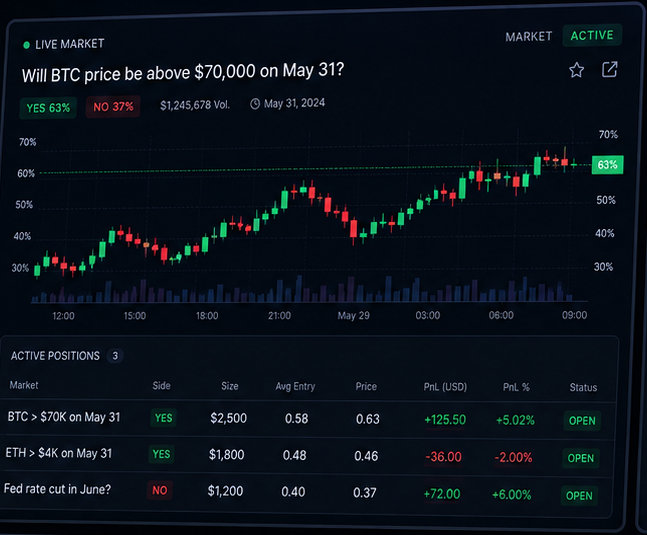
Live market state sits beside open positions, entry price and unrealised P&L — the context a candle-bound decision depends on.
Discover market→Align to boundary→Size position→Execute→Reconcile→Settle→Update state
On a blockchain venue, an order that appears to fail may already have gone through. The platform verifies the on-chain outcome-token balance before deciding whether an ambiguous order actually failed.
Strategy state has to survive process restarts too, so the desk resumes from where it actually is rather than from where it last remembered being.
Look under the hood ↘Discovery applies asset keywords, negative keywords, excluded tags, required market-type tags, timeframe tags and expected candle boundaries.
The position is recorded and strategy state advances, even though the original request appeared to fail.
Only then is the order considered unfilled, so a retry cannot duplicate a position that already exists.
Timezone-aware boundary logic handles US Eastern wall-clock intervals, with regression tests covering both daylight-saving transitions.
An ambiguous order is resolved against the on-chain outcome-token balance rather than the request result.
The platform is deliberately modest in its dependencies, because the difficulty here is not scale — it is correctness around timing, ambiguity and recovery.

Runs market discovery, candle scheduling, strategy evaluation, sizing and the execution path.
Discovery, timing and execution all depend on the same strategy state; separating them adds ways for them to disagree.

The desk: live market state, strategy configuration, executions and performance analytics.
An automated strategy still needs an operator who can see what it is doing and stop it.

The order book the platform trades against, with its own market metadata and settlement behaviour.
Many events carry similar titles; the wrong market will still accept an order.
The chain the outcome tokens live on, and the source of truth for whether an ambiguous order filled.
The balance is the only thing that actually knows whether the trade happened.

Persists strategy state, positions and execution history so the desk survives restarts.
A strategy that forgets its position on restart will size the next trade against the wrong picture.

Runs the engine as a supervised long-lived service, restarted automatically and fronted for the operator interface.
A candle strategy is only useful if it is actually running when the candle closes.
The architecture and product narrative reproduce the supplied project documentation. Interface values are product screen data and are not presented as investment results or evidence of future performance.
Technology names identify the documented implementation, not partnerships or endorsements.
Bring one automated execution path. In 30 minutes, we will map where timing, ambiguity and recovery have to be handled explicitly rather than assumed.
30 minutes · Your venue, strategy and constraints