Two workloads, two clocks
A spoken AI conversation needs immediate turn-taking; transcript analysis and summarization may run for seconds or minutes. Both have to coexist without blocking each other.
BrieflyAI lets users configure an AI expert in plain English, meet with that agent through a live video call, and automatically receive a structured summary, speaker-attributed transcript, recording and contextual follow-up chat after the session.
Live AI voice participation.
Durable transcript processing.

A spoken conversation needs immediate turn-taking; transcript analysis may run for minutes. Neither blocks the other.
Follow the lifecycle ↗Meeting intelligence
Real-time voice AI meeting platform
Product architecture to full-stack engineering
Building an AI that can answer questions is relatively straightforward. Building an AI participant that operates reliably across the complete lifecycle of a real meeting is a much broader product and engineering challenge.
Structured sessions need subject-matter experts, tutors, interviewers or trainers to repeatedly perform similar conversations. As demand grows, organizations either hire more experts or restrict how many sessions they can offer.
And when the conversation framework exists only in an employee's knowledge, different people deliver it differently — so the brief needs to be encoded into the system itself.
A spoken AI conversation needs immediate turn-taking; transcript analysis and summarization may run for seconds or minutes. Both have to coexist without blocking each other.
Call start, call end, transcript availability and recording completion all arrive asynchronously from the media provider — and may be delivered more than once.
Explanations, decisions, commitments and questions get trapped inside recordings, or disappear entirely when no structured notes exist.
Six views of the delivered platform.
Each shows another stage of the meeting lifecycle.
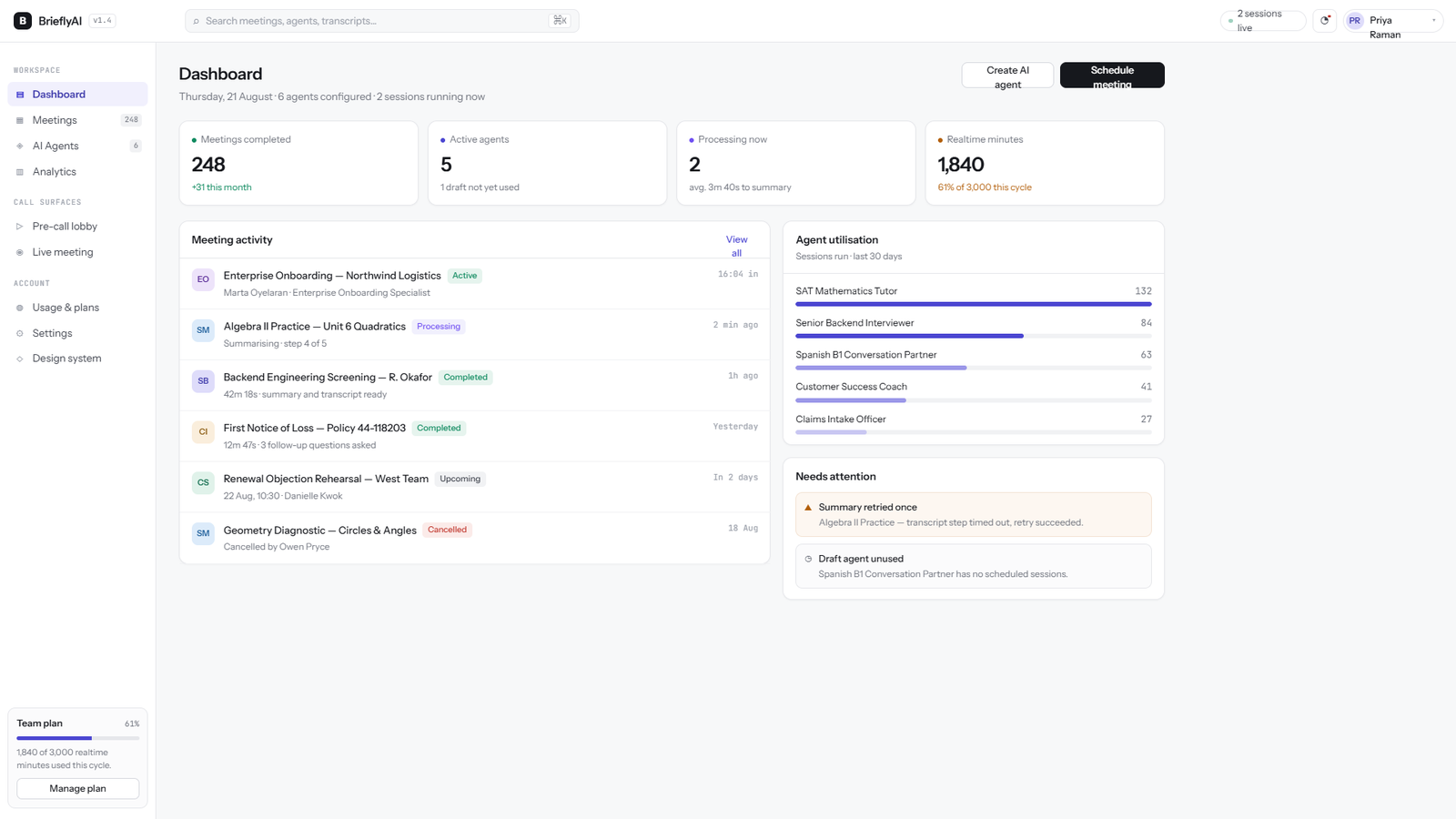
The dashboard brings configured agents and scheduled sessions together, so the same place that defines a conversation also runs it.
Configure→Schedule→Lobby→Converse→Process→Review
The two halves of the product have opposite requirements. Live conversation is latency-critical and cannot pause for analysis; transcription and summarization are slow and must survive failure.
So the slow work is handed to a durable pipeline. A dropped webhook never blocks the conversation record, and never duplicates it either.
Look under the hood ↘Real-time voice AI participates in the call with immediate turn-taking, under the agent identity the brief defines.
Turn-taking and speech happen at conversation latency, with the media infrastructure carrying the call.
Transcript, summary and recording are produced by background jobs that can retry without duplicating the record.
Transcript processing and summarization run in a durable pipeline rather than in the request path of the call.
Meeting lifecycle events arrive asynchronously and can repeat, so processing is built to tolerate both.
The implementation keeps live conversation and post-meeting processing in separate execution paths, so the latency requirements of one never become the constraint of the other.

Carries the workspace: agent configuration, meeting scheduling, the lobby, and the post-meeting review experience.
The place that defines a conversation is the place that runs and reviews it, so the lifecycle never leaves the product.

End-to-end typed procedures between the client and server, so the shape of meeting and agent data is agreed in one place.
Meeting state moves through many stages; a contract mismatch is far cheaper to catch at build time.

Runs the live video call and the chat surface, and emits the lifecycle events the platform reconciles against.
Call quality and delivery are their own engineering discipline; the product's value is the agent and the record, not the transport.

Gives the agent its spoken presence in the call, with the turn-taking latency a real conversation requires.
A participant that pauses to think is not a participant — live conversation and batch analysis are different problems.
Runs transcript processing and summarization as durable background work, outside the live conversation path.
A dropped webhook never blocks the conversation record — and retries never duplicate it.

Holds agents, meetings, transcripts and summaries as the durable record of every session.
A meeting is a set of related facts — agent, participants, transcript, summary — and they are queried together.
The architecture and product narrative reproduce the supplied project documentation. Interface values are product screen data.
Technology names identify the documented implementation, not partnerships or endorsements.
Bring one structured session your team runs over and over — tutoring, interviewing, intake, onboarding. In 30 minutes, we will map what an AI participant could hold, and what still needs a person.
30 minutes · Your session format and constraints