Latency turns a class into a broadcast
Participants need to feel the instructor is leading now. Beyond a certain delay, the social contract of a live class quietly breaks.

FitFusion combines instructor-led live classes, real-time participant interaction, automatic session recording and Apple Watch biometrics into one workout — with the media path deliberately separated from the application path.
Live classes and wearables.
Recording on its own path.
The backend decides who the user is and which class they may enter. Authorized clients then connect to the managed real-time environment directly, rather than routing live video through application servers.
Follow a session ↗Fitness technology / digital wellness
Live class platform with wearable biometrics
Mobile, wearable and real-time architecture
Pre-recorded workout libraries offer flexibility, but they lack the accountability, immediacy and community of attending a live class.
Recreating that means a remote participant has to feel an instructor is genuinely leading the session in real time. Excessive latency, unstable connections or disconnected interaction quickly turn a live workout into a delayed broadcast.
And a live session should keep earning after it ends — which makes recording a workflow problem, not a button.
Participants need to feel the instructor is leading now. Beyond a certain delay, the social contract of a live class quietly breaks.
A live workout should continue generating value once the session ends — so recording has to happen automatically and hand off to processing without anyone waiting on media.
Heart rate, calories and elapsed time are most useful mid-exercise. Capturing them from Apple Watch and HealthKit has to avoid excessive networking and wearable battery drain.
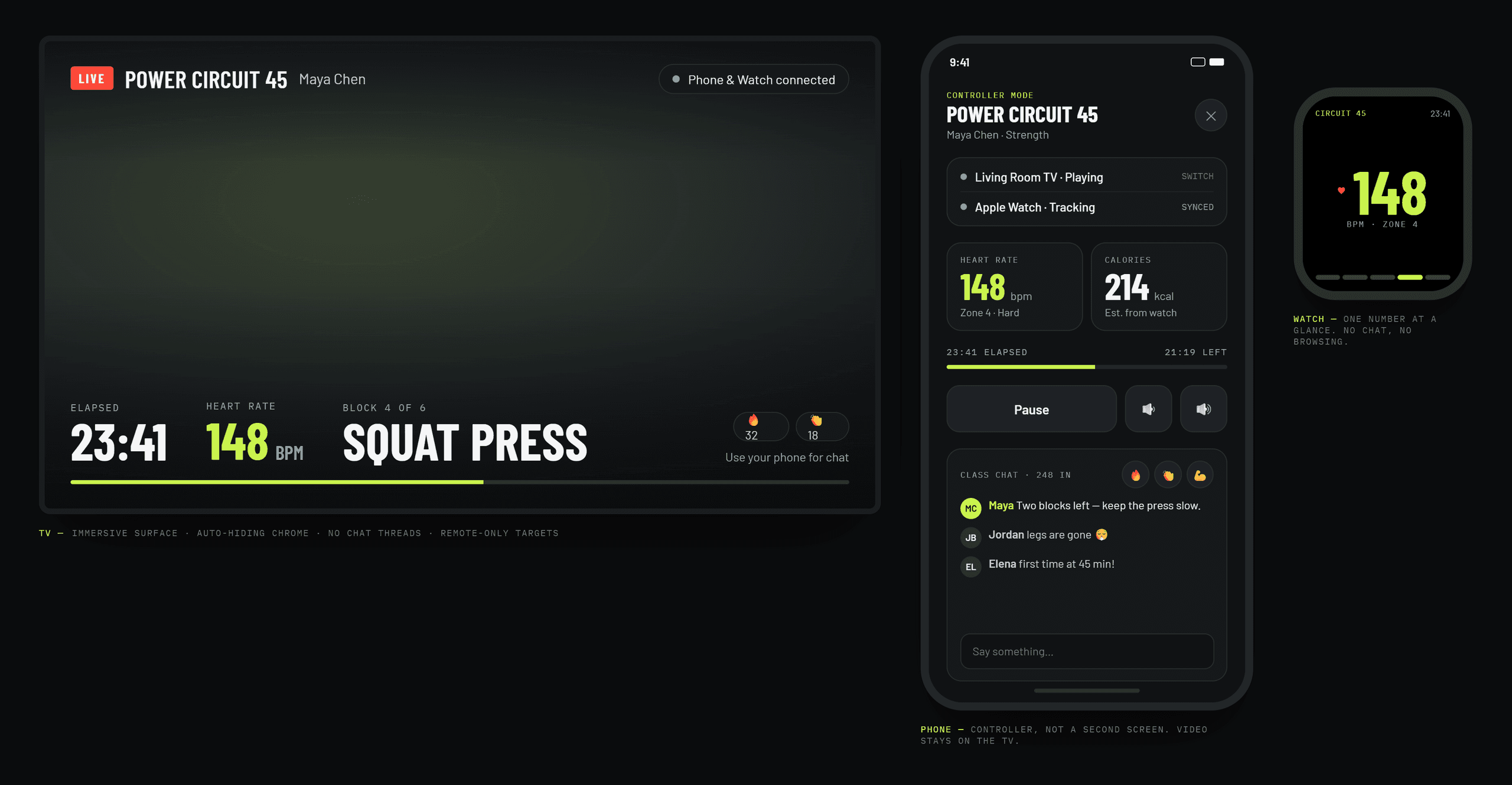
Four views of the delivered mobile and wearable experience.
Each shows another part of a live session and what it leaves behind.
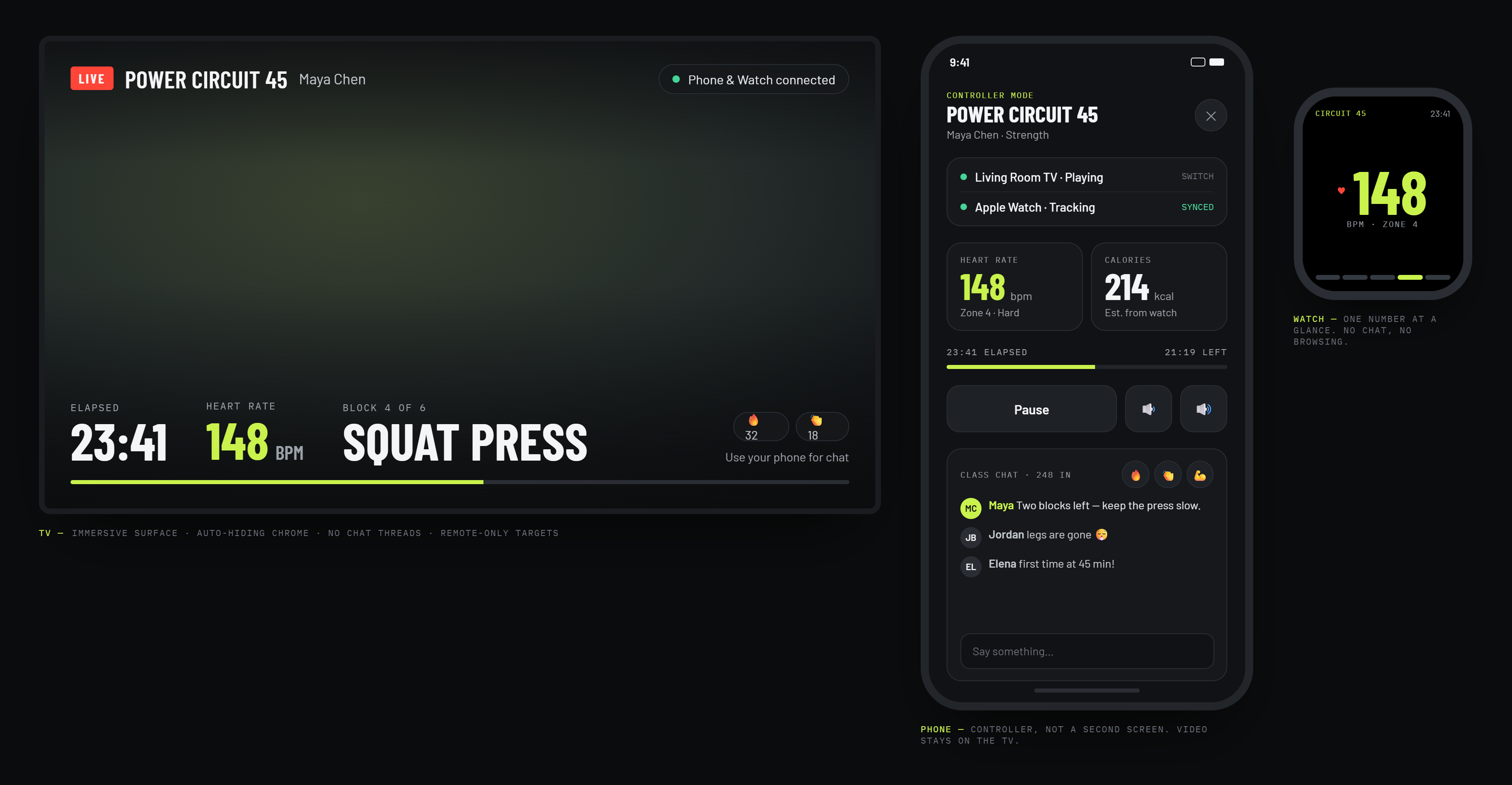
Participants join scheduled classes through a real-time video environment, with short-lived session credentials issued after the backend has validated that they are authorized to enter.
Browse→Enrol→Authorize→Join→Capture→Finish→Replay
The backend determines who the user is and which class they may enter, then issues short-lived credentials. Authorized clients connect to the managed real-time environment directly, so live video never travels through application servers.
That separation is what lets recording and replay proceed on their own schedule: processing continues asynchronously after a class ends, and the session becomes replay content once it is done — without the live path having to stay healthy for it to succeed.
Look under the hood ↘Authorization happens in the application plane, and the participant receives short-lived credentials rather than a permanent key to the media environment.
Participants stream and interact while the session is captured on the media plane, with neither path depending on the other's throughput.
Because capture does not run through the application path, a degraded or reconnecting live experience does not take the replay down with it.
Live classes are recorded without instructor action, and processing continues after the session finishes rather than holding anyone up.
Biometrics are captured on the Watch and selectively synchronized to the phone, keeping networking and battery cost proportionate to the value of the metric.
Two decisions carry the stack: real-time media is a specialism worth buying rather than operating, and wearable health data is a place where a cross-platform abstraction costs more than it saves.

The shared participant experience — browsing, enrolment, joining a session and in-class interaction.
Shared mobile workflows benefit from one codebase, while the Apple-specific wearable and health work stays native rather than being forced through an abstraction.

Typed contracts across the mobile application, keeping session, class and participant shapes explicit.
Session state moves between the application plane, the media layer and the wearable. Ambiguity about its shape is where multi-device products break.

The low-latency media layer for instructor-led sessions, joined directly by authorized clients rather than proxied through application servers.
Globally distributed RTC involves networking, codec, NAT traversal and scaling concerns. Buying that lets the team spend its effort on the fitness product and its access rules.
A dedicated real-time path for the short messages and reactions exchanged during a class.
Interaction has to stay responsive enough to feel social while remaining light enough that people can keep exercising through it.

The Apple Watch application, scoped to glanceable workout data and native device capability.
The wearable is not a small phone. Its value is immediate physical feedback, which needs the platform's own APIs rather than a port of the mobile UI.

Access to Apple-platform workout and biometric information — heart rate and calorie data used by the wearable experience.
Native health APIs are the supported path to Apple Watch fitness data, and a cross-platform framework alone is not sufficient for every wearable workflow.
The confirmed product foundation is the React Native mobile application, the Apple Watch companion with HealthKit integration, Agora-powered live video and messaging, and automatic session recording. The source additionally describes web, TV, backend topology and AWS infrastructure as a production-grade extension of that foundation; those surfaces are not claimed here.
Technology names identify the documented implementation, not partnerships or endorsements.
Bring one real-time experience where something valuable has to survive the session — a recording, a transcript, a set of metrics. In 30 minutes, we will look at which planes your product has, and which of them are currently load-bearing for each other.
30 minutes · Your live experience and what it leaves behind