Category alone does not answer the question
Clothing, books, toys and accessories describe what a product is, not who it suits — which is where a parent actually starts.

KidNest places age at the centre of product discovery while providing what shoppers expect from a modern store — search, filtering, wishlists, persistent carts, secure checkout and fast mobile browsing.
Age-based discovery.
Webhook-verified checkout.

A parent looking for a gift for a four-year-old should not browse hundreds of unrelated products first.
Follow the journey ↗Retail & e-commerce
Full-stack commerce platform
Product architecture to AWS infrastructure
Parents shopping for children's products make purchasing decisions differently from customers using a conventional online store. For toys, books, clothing and baby essentials, age suitability is often just as important as category or price.
Parents typically begin with a question — what products are suitable for a 3-to-5-year-old? So the product model had to treat age range as a fundamental attribute rather than an optional secondary filter.
Rather than adapting a generic store template, the platform was designed around that buying behaviour from the data model up.
Clothing, books, toys and accessories describe what a product is, not who it suits — which is where a parent actually starts.
Shoppers browse several times before buying, so carts, wishlists and selections have to survive — for registered customers across devices, and usefully for guests too.
Browser-side confirmation is not evidence that money moved. Order confirmation had to come from trusted server-side events, with card data never touching the application server.
Six views of the delivered platform.
Each shows another step of the shopping journey.
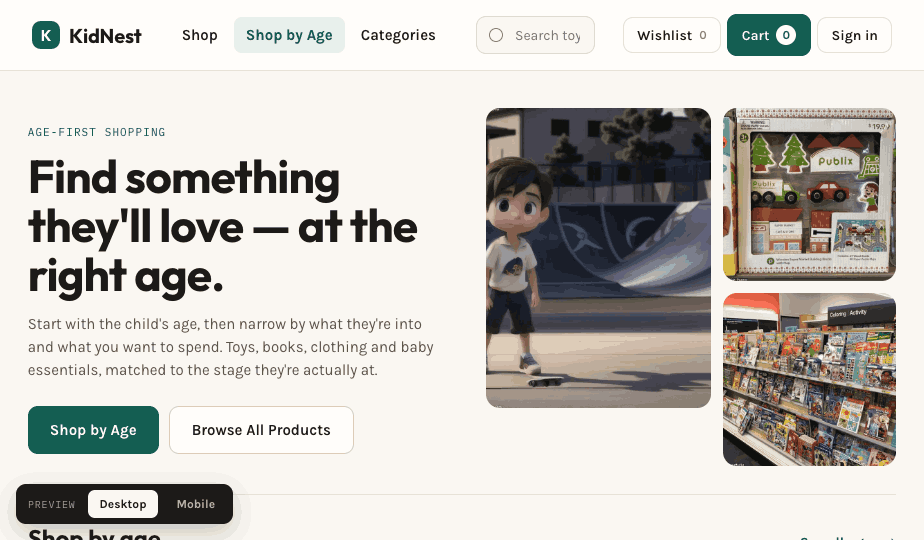
The landing experience puts age-based entry points alongside the search and category browsing shoppers already expect.
Discover by age→Product detail→Cart→Checkout→Payment intent→Webhook confirm
Payments could not rely on browser-side confirmation. The platform creates Payment Intents server-side, validates Stripe events, and confirms orders only from trusted server-side signals — with refund workflows supported on the same path.
Duplicate payment actions are prevented rather than reconciled later, and card data remains outside the application server throughout.
Look under the hood ↘The backend creates the Stripe Payment Intent, so the amount and order being paid for are established by the server.
Authenticated state, carts and wishlists persist server-side so the journey resumes anywhere.
Guests keep a useful local cart without being forced through registration before they are ready.
Stripe events are verified before they are believed, and duplicate payment actions are prevented.
The order moves to confirmed on the validated server-side event — not on the browser's report of success.
The platform needed an infrastructure foundation able to absorb traffic peaks around holidays and back-to-school shopping, without making the application unnecessarily complex during normal usage.

Carries discovery, product detail, cart, wishlist and checkout as one fast, mobile-friendly storefront.
Parents browse in short bursts on a phone, so the discovery path has to work at that size before any other.

Serves the catalogue, cart, wishlist and order APIs, and owns every payment decision.
A browser can be manipulated; an order that confirms on a browser claim is an order that can be faked.

Holds products with age range as a first-class attribute, alongside carts, wishlists and orders.
Discovery is only as good as the data model; age as an afterthought filter cannot lead the experience.

Payment Intents, signed webhook events and refund workflows, with card data never reaching the application server.
It is the only signal that actually knows the payment succeeded, and it is signed.

Keeps authenticated state so registered customers' carts and wishlists follow them between sessions and devices.
Shoppers browse several times before buying — a cart that forgets is a sale that does not happen.

Application hosting, managed database, media storage and CDN delivery for product imagery.
Product photography is the heaviest thing on the page, and discovery lives or dies on how fast it renders.
The architecture and product narrative reproduce the supplied project documentation. Interface values are product screen data.
Technology names identify the documented implementation, not partnerships or endorsements.
Bring one part of your commerce journey — discovery, the cart, or checkout. In 30 minutes, we will map where the data model, the session and the payment path have to agree.
30 minutes · Your catalogue, journey and constraints