Similarity blurred ownership
Boilerplate language made unrelated records look semantically relevant.
NoteGraph turns near-identical clinical notes into a governed knowledge graph, then combines vector anchoring with explicit patient and encounter relationships to produce source-linked answers clinicians can inspect.
Relationship-aware retrieval.
Evidence-support boundary.

Citations resolve to authorized source notes, while trace IDs preserve the retrieval and model configuration behind the response.
Follow the evidence ↗Clinical documentation
Governed GraphRAG platform
AI, cloud & product engineering
Templated OBGYN notes can be lexically near-identical across unrelated patients. Plain keyword or vector search may retrieve a persuasive-looking passage that belongs to the wrong encounter.
That is not a ranking inconvenience. In a clinical workflow, it is the wrong evidence attached to the right-sounding answer.
NoteGraph treats patient, encounter, finding, and referenced-visit relationships as retrieval evidence—before the model sees context.
Boilerplate language made unrelated records look semantically relevant.
Clinicians required the note, encounter, evidence span, and provenance—not an opaque summary.
Grounding, refusal, authorization, and retrieval quality needed explicit tests and operational signals.
The clinical experience keeps the reasoning path visible: encounter-scoped conversations, source-linked citations, and an evaluation surface for retrieval and generation quality.
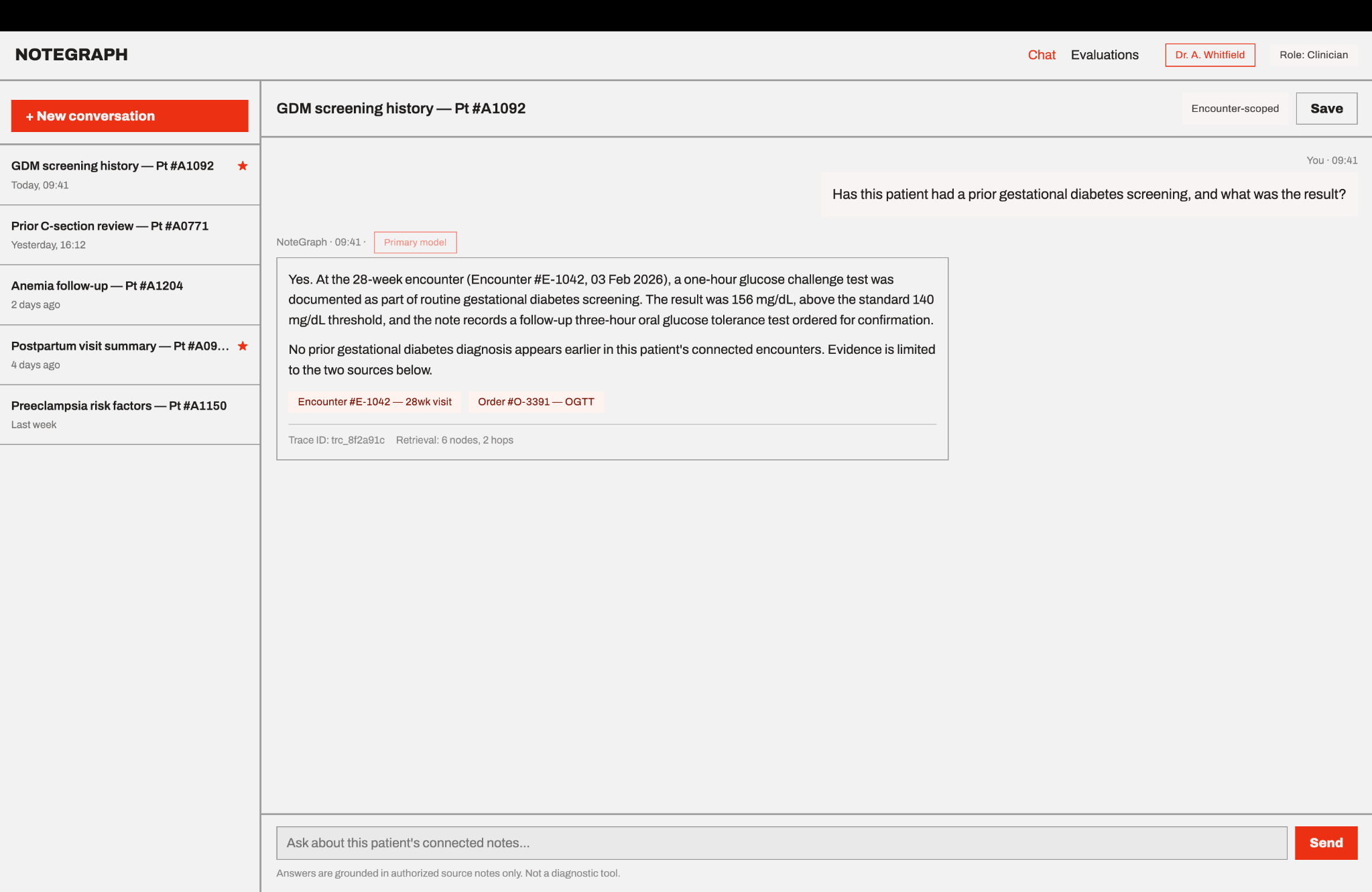
The clinician asks across a patient’s record. NoteGraph returns a bounded answer, source chips, retrieval trace details, and a clear statement when evidence is limited.
Authenticate→Rewrite→Vector anchor→Graph traverse→Rerank→Guard→Stream & cite
The query first locates semantically relevant anchor nodes. Bounded openCypher traversal then expands only through approved clinical relationships, and a policy reranks the result by relevance, graph distance, recency, and evidence quality.
Look under the hood ↘Identity, role, tenant, request ownership, and source permissions are checked before context assembly.
Vector similarity identifies likely notes, findings, or encounters without deciding clinical belonging.
Patient, encounter, finding, and referenced-visit edges constrain what can join the answer context.
The model can use only the retrieved, authorized evidence and must surface insufficiency or contradiction.
Citations, trace ID, and configuration versions travel with the completed answer.
Clinical relationships stop near-duplicate text from becoming cross-patient context.
NoteGraph answers from retrieved, authorized documentation, cites the source, and states when the record is insufficient. Diagnosis and treatment decisions remain outside the product boundary.
The stack separates graph evidence, transactional product data, transient connection state, and immutable provenance—so each store and workload can be secured, scaled, audited, and recovered independently.

Runs semantic anchor search and bounded openCypher traversal against one governed clinical graph.
Similarity and relationship expansion operate on the same governed entities instead of drifting across disconnected databases.

Provides embeddings, schema-constrained extraction, tiered Claude inference, streaming, and guardrails.
High-complexity synthesis uses the primary model while helper and fallback paths stay explicit, versioned, and measurable.

Coordinates validation, OCR, normalization, de-identification, graph construction, and quality gates.
Long-running clinical data work becomes replayable and observable without hiding failures inside request-time functions.

Raw, quarantined, and curated zones retain immutable versions, manifests, graph records, and evaluation datasets.
The graph can be rebuilt deterministically; corrupt state becomes a recovery procedure rather than a data-loss event.

Owns users, conversations, messages, and configuration separately from the clinical graph.
Clinical evidence and chat-product state receive different authorization, retention, backup, and blast-radius controls.

Federated identity, MFA, JWT authorization, HTTP APIs, and ordered WebSocket answer streams form the product edge.
The right to ask a question never implies the right to open every source note; policy is enforced on both paths.
Version, checksum, classify, deduplicate, and route failures to replayable queues.
OCR scanned notes and produce schema-constrained clinical entities and relationships.
Publish only after node, edge, orphan, and schema quality gates pass.
Combine semantic relevance with explicit clinical connectivity.
Return bounded answers with citations, trace IDs, and configuration versions.
The supplied interface presents an evaluation dashboard with representative project metrics. Formal performance and regulatory acceptance remain governed by the client-approved golden dataset, target thresholds, environment, and applicable compliance review.
Cloud architecture does not itself confer regulatory compliance. Production PHI processing requires the applicable agreements, service-and-region review, threat model, approved operational controls, retention policy, and client governance. NoteGraph is positioned as evidence-support software—not autonomous clinical decision software.
Technology names identify the documented implementation, not partnerships or endorsements.
A golden evaluation dataset turns retrieval and answer quality into release evidence. Operators can inspect anchor precision, connected-context recall, grounded answers, unsupported claims, fallback use, latency, and denied queries by run.
The important move is organizational: retrieval, generation, experience, and security are measured together, because a clinically useful answer must pass all four.
Anchor precision · connected-context recall
Grounding · unsupported claims · refusal quality
Streaming health · time to first token
Denied queries · unusual source access
The assistant must state when authorized notes do not support the requested conclusion.
A citation is not a bypass; source inspection applies the same role and tenant policy.
Retries and model-route changes are recorded rather than silently changing behavior.
Curated records and manifests preserve a deterministic recovery path.
Bring one regulated or relationship-heavy document workflow. In 30 minutes, we’ll map the evidence model, authorization boundary, evaluation contract, and a practical engineering next step.
30 minutes · Your use case, constraints, and next step
30 minutes · Your use case, constraints, and next step