Information buried in files
Products, quantities, and specifications arrive across email, PDF, Word, and Excel.
From the first RFQ email to the final invoice. A real procurement platform, engineered by Cosmoxyn to bring documents, decisions, and delivery into one workflow.
Email-native procurement.
AI-assisted document intelligence.

Source email, line items, vendor quotes, and bid packets—in context.
Follow the workflow ↗Procurement & B2B distribution
Web platform + email automation
Architecture to cloud & DevOps
An RFQ in the inbox. Vendor prices in a spreadsheet. A purchase order in another thread.
For procurement teams, the work continues between every system. Re-entering line items. Comparing supplier responses. Reconstructing what was quoted, awarded, shipped, and invoiced.
ProcuraFlow was built to preserve that continuity across the entire commercial transaction.
Products, quantities, and specifications arrive across email, PDF, Word, and Excel.
Vendor replies and pricing need to stay attached to the right sourcing request.
Post-award changes and partial shipments need a record teams can follow.
Explore three views of the real platform.
Each makes another part of the transaction visible.
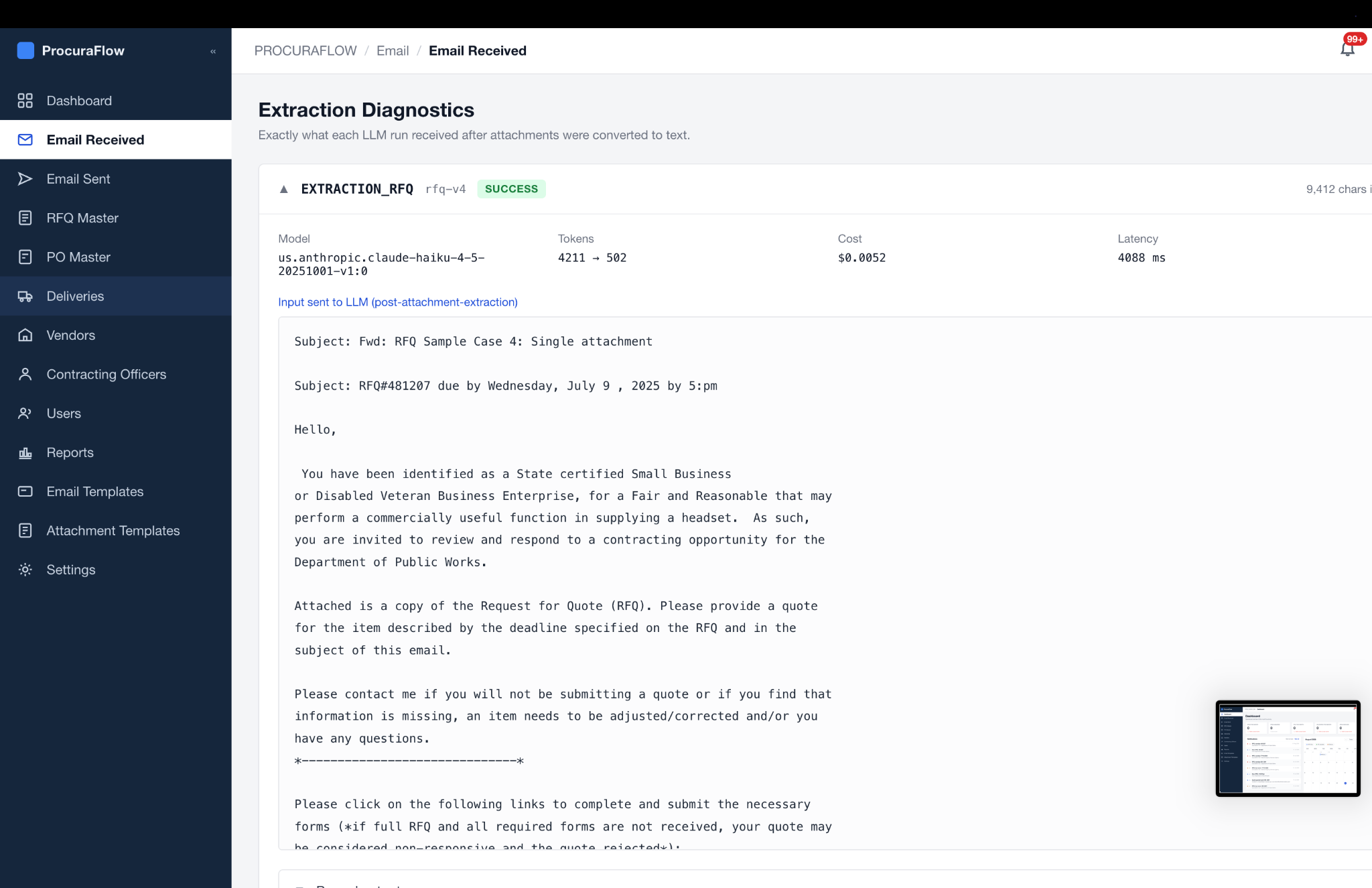
Extraction diagnostics expose the source content and run details, including tokens, cost, and latency. Teams can inspect what the model received instead of treating extraction as a black box.
RFQ→Sourcing→Bid comparison→Customer quote→Purchase order→Delivery→Invoice
Procurement needs more than a convincing answer. It needs structured records, consistent pricing, and decisions an operator can inspect.
Look under the hood ↘Email content + extracted attachment text
Known markers and document patterns
Bounded classification assistance
Structured output, validated before use
Confidence, diagnostics, and human intervention
Behind the procurement workflow is a deliberately connected stack. Here is what each part does—and how the documented engineering choices support the operation.

The web interface brings RFQs, vendor bids, orders, and deliveries into one operational workspace.
Shared types and schema contracts help the interface and backend agree on the shape of procurement data.

The API serves the application while a separate worker processes incoming documents and scheduled work.
Slow extraction jobs and retries can run without blocking normal user requests. Both processes share one codebase.

Procurement records and durable background jobs live in PostgreSQL, with Drizzle handling database access.
Jobs survive worker restarts and support retries without operating a separate message broker.

AI converts unstructured procurement documents into schema-constrained data. Rules handle clear classification signals first.
Straightforward decisions remain deterministic and testable. AI is used where document interpretation adds value.
AWS receives procurement emails and retains original messages and attachments for downstream processing.
Structured records remain connected to the documents that produced them, preserving context across handoffs.

Shared schemas define API inputs, application types, and the expected shape of AI extraction output.
Validation before operational use reduces contract drift between the interface, API, and extraction pipeline.
Supporting libraries and integrations, grouped by their role in the platform. Reporting integrations apply where configured.
Technology names identify the project stack, not partnerships or endorsements.
Bring one operational bottleneck.
Let’s explore what a more connected system could look like.
30 minutes · Your workflow, constraints, and next step
30 minutes · Your workflow, constraints, and next step