Price action is not the full picture
Market prices, liquidity, indicators, news and sentiment have to be combined into one consistent context that agents can reason over.

An AI-powered crypto trading platform where autonomous agents research markets and form trading decisions, deterministic risk controls decide whether the trade is allowed, and a dedicated execution layer handles blockchain interaction.
Multi-agent research.
Deterministic risk control.

An LLM is a useful reasoning system, but not an appropriate authority for enforcing financial limits.
Follow the decision ↗Digital asset trading
AI + Web3 trading platform
Architecture, AI systems & blockchain engineering
Crypto traders have access to sophisticated market data, decentralized exchanges and AI models, but these normally exist as disconnected tools — centralized-exchange prices, DEX liquidity, technical indicators, news and sentiment all monitored separately.
A generic AI-generated signal is difficult to evaluate when real capital is involved. Users need to know what evidence was considered, which analytical perspectives agreed or disagreed, what the final thesis was, and why risk controls approved or rejected it.
So AI reasoning had to become part of the product experience rather than a black box that emits a verdict.
Market prices, liquidity, indicators, news and sentiment have to be combined into one consistent context that agents can reason over.
Prompting a model with “do not exceed a 5% position size” does not provide the same guarantee as implementing that restriction in deterministic code.
The platform had to work across fundamentally different venue architectures, each with its own liquidity and settlement behaviour.
Five views of the delivered platform.
Each shows another stage between research and execution.
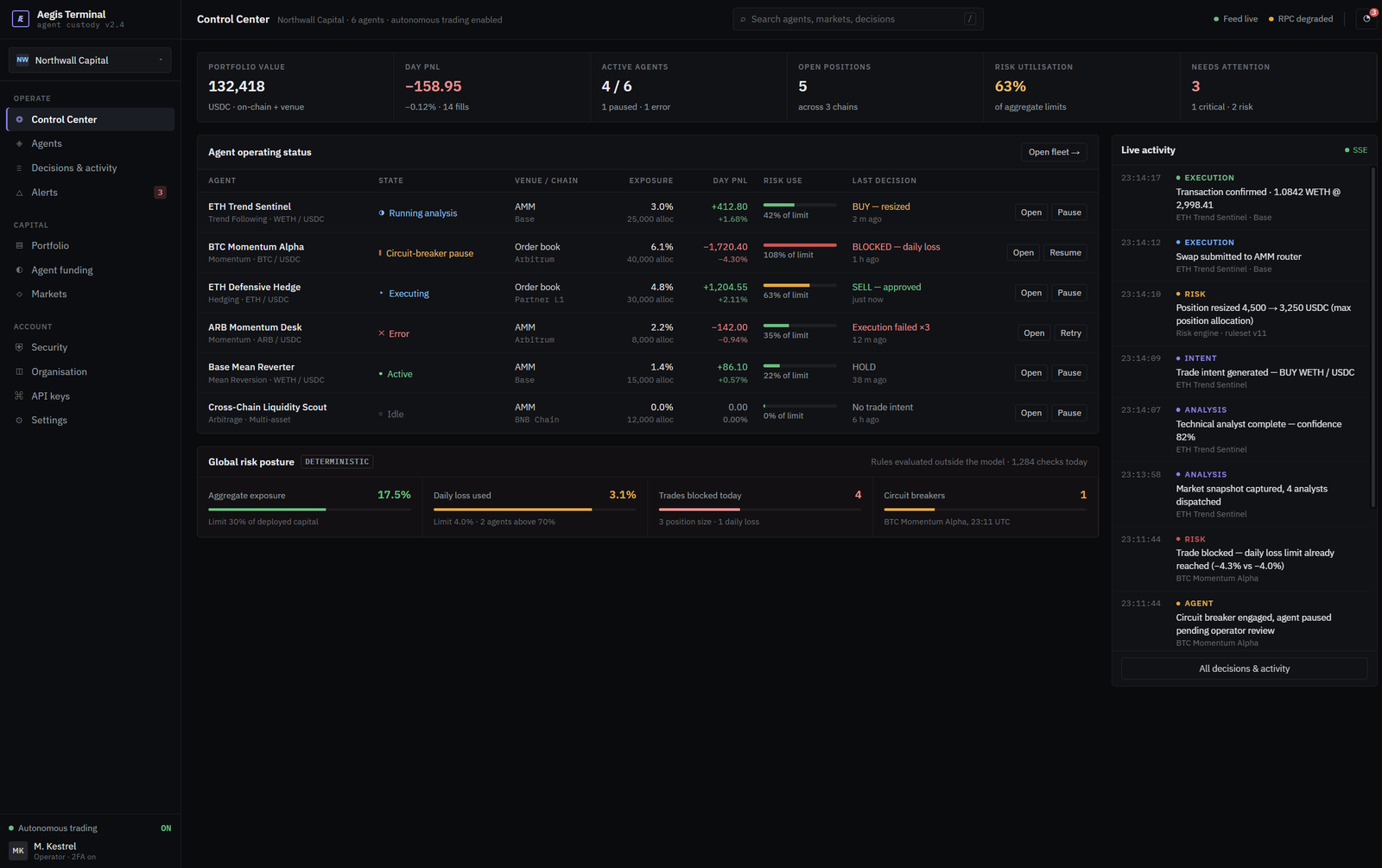
Market prices, liquidity, indicators, news and sentiment are combined into the consistent context agents reason over.
Gather context→Agent research→Form thesis→Risk check→Authorize→Execute on-chain
The platform separates three responsibilities: AI generates the trading thesis, deterministic software decides whether the trade is allowed, and a dedicated execution layer handles blockchain interaction.
The result is a foundation for building AI-native trading products without giving a language model unrestricted authority over user capital.
Look under the hood ↘Multi-agent research combines market data, indicators, news and sentiment into a reasoned trading proposal.
The decision passes to the execution layer with its parameters fixed by the risk tier, not by the model.
A rejected proposal keeps its reasoning and hash, so why the controls refused is as inspectable as why the agent proposed.
Position limits and risk rules are enforced in code, so approval or rejection is a guarantee rather than an instruction.
Only an authorized decision reaches the venue, through a layer built for blockchain interaction.
The stack follows the separation the product depends on: an experience tier, a reasoning tier, and an execution tier that is the only part holding authority to interact with a chain.

Web and mobile surfaces carrying market context, agent activity, decision records and portfolio state.
Traders monitor from a desk and act from a phone; the decision record has to be legible on either.

The application tier serving the product surfaces and coordinating between reasoning and execution.
It keeps the product experience independent of both model behaviour and chain latency.

Runs the multi-agent research pipeline that combines market data, indicators, news and sentiment into a thesis.
Reasoning is probabilistic and slow; it must not sit in the path that enforces limits or submits a trade.

Preserves every decision with its reasoning and content hash, alongside the fast-moving state the platform reads continuously.
A preserved reasoning trail is only trustworthy if it can be shown not to have changed after the fact.

The execution layer's interface to blockchain networks and decentralized venues.
Chain interaction is where authority over funds lives, so it is deliberately the narrowest, most explicit part of the system.

Typed structured signing for wallet interactions across the supported networks.
A user should be able to see what they are authorizing, not sign an opaque payload.
The architecture and product narrative reproduce the supplied project documentation. Interface values are product screen data and are not presented as investment results or evidence of future performance.
Technology names identify the documented implementation, not partnerships or endorsements.
Bring one AI-assisted decision your product makes. In 30 minutes, we will map which part is reasoning, which part must be deterministic, and where the boundary belongs.
30 minutes · Your venues, controls and constraints