The corpus was not reliably searchable
Arabic OCR, bidirectional text, image-based tables, and diagram-carried constraints made simple PDF search incomplete.

Regulyn brings bilingual regulatory knowledge, spatial and policy analysis, formal review gates, and committee casework into one traceable workflow—so every answer and recommendation can be followed back to its source.
Bilingual document intelligence.
Governed committee casework.

Analysis, endorsement, committee, recommendation, and decision progress remain visible together.
Follow the workflow ↗Regulatory & public-sector governance
Document intelligence + case management
Product, AI & full-stack engineering
It needs the regulation, section, page, exact supporting text, authorized reviewer, case history, and the record of how a committee reached its recommendation.
Scanned Arabic and English regulations resist ordinary search. Diagrams and rasterised tables carry rules that text extraction misses. Meanwhile, development requests move through email, attachments, analysts, consulted entities, quality review, and committee meetings.
Regulyn was designed to connect regulatory knowledge and formal governance without allowing AI to become the decision-maker.
Arabic OCR, bidirectional text, image-based tables, and diagram-carried constraints made simple PDF search incomplete.
Analysts needed the exact clause on the exact page—not a fluent summary detached from its evidence.
Completeness, analysis, endorsements, quality review, committee action, and minutes lacked one attributable trail.
Explore the supplied product views behind caseload control, spatial evidence, quality gates, and regional retrieval.
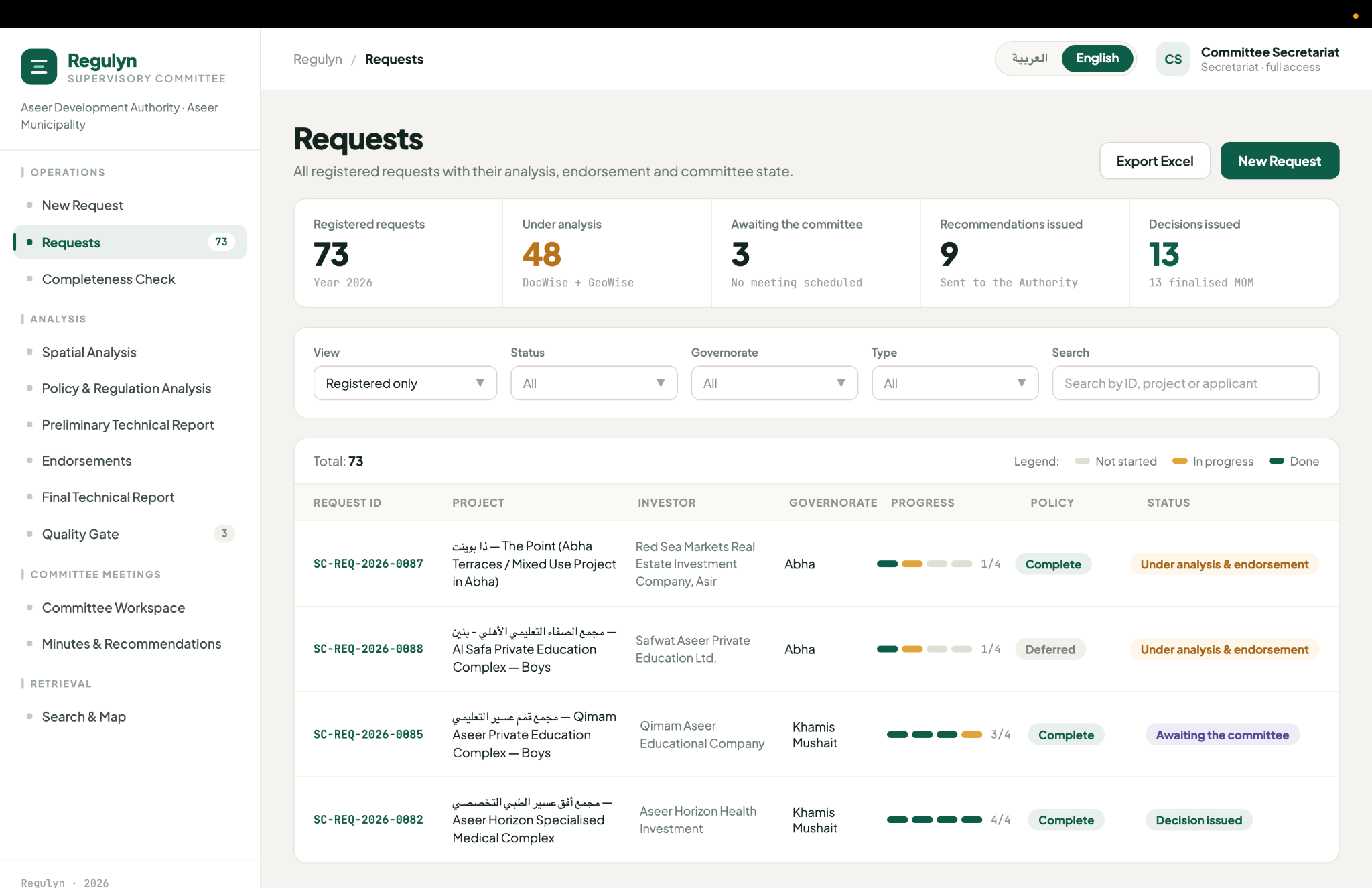
Requests can be filtered by status, region, and type while the progress of analysis, endorsements, committee review, recommendation, and decision remains legible.
Register→Completeness→Analyse→Endorse→Quality gate→Committee→Minutes
Regulyn separates extraction, validation, retrieval, analysis, and formal authority. Knowledge does not become queryable before review, and technical analysis does not pre-empt the committee.
Look under the hood ↘OCR and AI create a draft knowledge record for subject-matter review.
Approved clauses, figures, tables, page geometry, and access rules enter the searchable corpus.
Original extraction and human corrections remain distinguishable and auditable.
Document · section · page · text snippet · highlighted source region
The system informs and records; authorized people review, recommend, and decide.
The architecture separates the bilingual product experience, versioned API, asynchronous document pipelines, hybrid retrieval, governed operational data, and access enforcement.

Role-specific workspaces support English and Arabic, direction-aware layouts, streaming responses, and formal casework.
One typed interface can serve analysts, reviewers, administrators, committee users, and external responders without flattening their roles.

Typed APIs keep intelligence, governance, export, and administration rules outside the presentation layer.
Stable contracts, machine-readable errors, and centralized authorization are essential across a large operational surface.

Relational records preserve cases, approvals, and audits while dense and sparse vectors support hybrid retrieval.
Governance needs transactions and history; evidence retrieval needs semantic, keyword, scope, and metadata filtering at query time.

Parsing, extraction, indexing, workflows, exports, and ad-hoc work run outside request-response paths with progress events.
Long document jobs can resume from tracked, idempotent stages instead of restarting after a worker or provider failure.

Scanned text, tables, figures, annotations, page dimensions, and detected images are retained as source-linked artifacts.
A citation must open the correct page and highlight the exact supporting region to be defensible.

Role checks, closed governance permissions, document-level access, rate limiting, and immutable audit records protect the decision trail.
Restricted content must never become a search hit, model context, or citation—not merely disappear from the final screen.
Document, page geometry, tables, figures, and language metadata.
Original extraction and reviewer correction remain separately attributable.
Hybrid retrieval applies document and user access before evidence reaches the model.
Every supported claim can open against its precise source location.
The page uses the client-facing portion of the supplied case study. Product screens contain illustrative prototype data; displayed counts, places, statuses, and spatial findings are not presented as measured outcomes or verified client results.
The documented implementation covers bilingual presentation, APIs, asynchronous processing, operational and vector data, object storage, identity, and retrieval quality.
Technology names identify the documented implementation, not partnerships, certifications, or endorsements.
Bring one document-heavy regulatory, compliance, or committee workflow. In 30 minutes, we’ll map the evidence trail, human authority boundary, and a practical automation opportunity.
30 minutes · Your process, evidence, and next step
30 minutes · Your process, evidence, and next step