Knowledge was separated from work
SOPs, policies, training material, and business rules were disconnected from the operational system of record.
Rent Manager AI was designed as a governed intelligence layer for property teams—grounding answers in company knowledge and operational data, then routing consequential actions through explicit approval, verified execution, and audit.
Property operations.
Governed AI workflows.

Operational data, company knowledge, and permitted tools come together without giving the model unchecked authority.
Follow the interaction ↗Property management operations
Governed AI operations layer
Product, AI & integration architecture
Property teams work across leases, ledgers, maintenance records, tasks, tenant communication, SOPs, and policy documents. The question is simple; assembling a reliable answer often is not.
An AI interface can reduce that friction—but only if it respects permissions, separates advice from execution, and never reports success before the property system confirms the change.
The engagement defined an architecture where the model can understand, retrieve, reason, and propose. Application logic remains responsible for authorization, approval, execution, verification, and audit.
SOPs, policies, training material, and business rules were disconnected from the operational system of record.
Receivables, occupancy, maintenance, tasks, and documents required different views and repeated reconstruction.
Charges, renter data, lease records, and work orders could not be changed by an unrestricted model.
Explore the supplied product concepts for grounded questions, approval-gated work, maintenance visibility, and portfolio context.
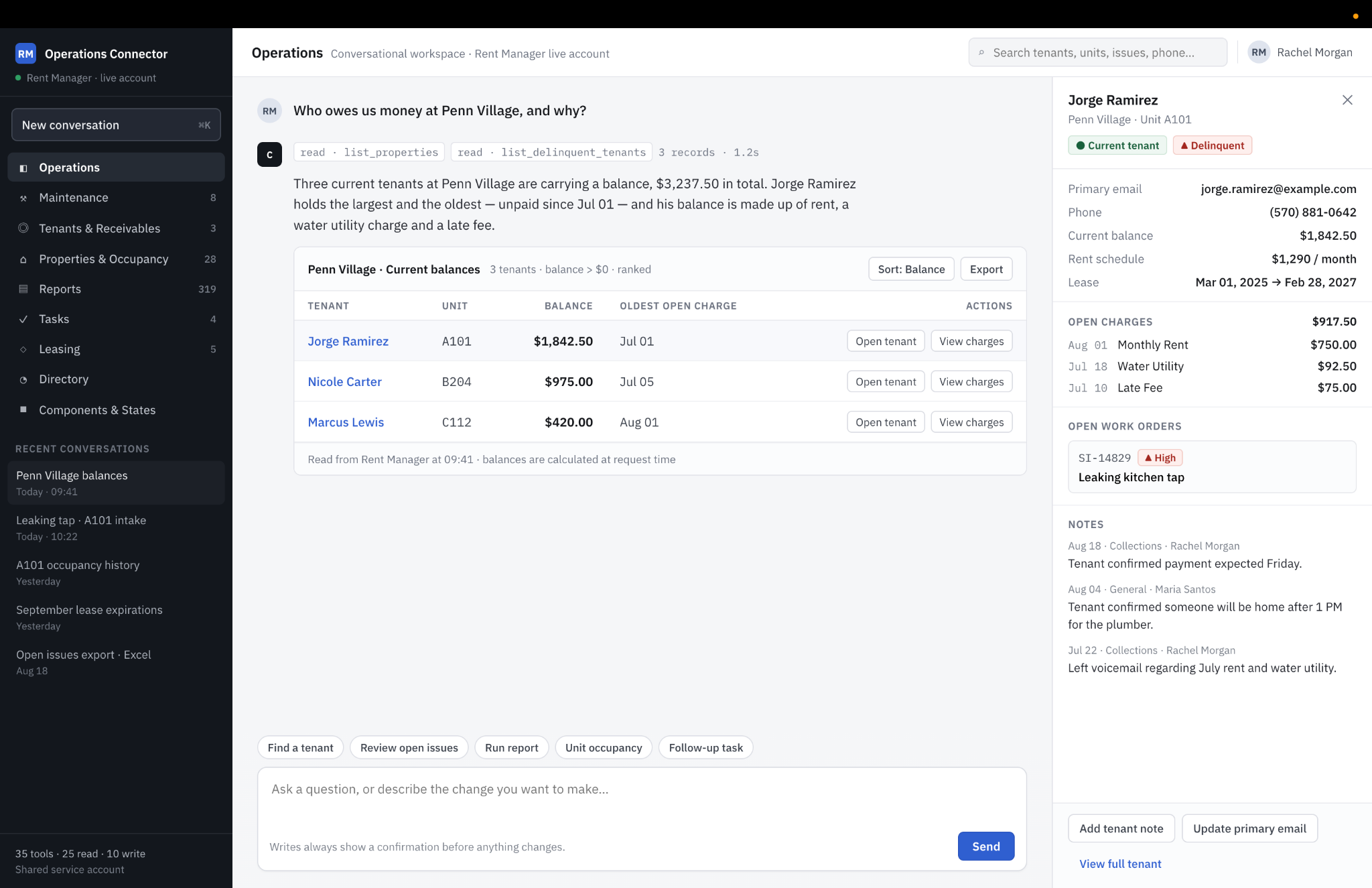
The workspace translates a property-operations request into controlled tool use and presents a grounded, readable response with its supporting context.
Understand→Retrieve→Reason→Propose→Approve→Execute→Verify→Record
Read-only questions can use permitted operational tools and relevant company knowledge. A consequential change becomes a reviewable proposal—showing the action, current state, intended state, policy context, and risk—before any write is attempted.
Look under the hood ↘Tenant-scoped knowledge · role permissions · current operational data
Use permitted tools, expose supporting context, and preserve traceability.
Show before/after state and do not write until an authorized person approves.
Application logic authorizes and invokes the approved system operation.
Confirm the downstream result, surface failure honestly, and write the audit record.
Turn a natural-language request into an explicit operational need.
Use tenant-safe documents, policies, permissions, and live system data.
Keep sensitive write operations behind a human authorization gate.
Confirm downstream state and preserve a traceable execution history.
The proposed architecture separates conversation, retrieval, orchestration, approval, integration, and observability—so model reasoning never becomes an implicit authorization layer.

Chat, knowledge, approvals, and usage views share a permission-aware product surface.
Operational state stays explicit while server data, pending actions, and verification states remain easy to reason about.

A typed modular monolith owns authorization, workflows, validation, and controlled business execution.
Business rules and permissions belong in deterministic application code, not probabilistic model output.

A gateway coordinates model access and embeddings while keeping providers behind an application boundary.
Central control improves configuration, observability, and future model portability.

Operational metadata and vector retrieval share a relational core designed around organization isolation.
Document relevance is useful only when every query remains inside the correct organization boundary.

Read and write tools are exposed through a controlled integration layer, with writes routed through approval.
System credentials, tool permissions, and downstream behavior can evolve without weakening the application boundary.

Tracing, token and cost visibility, operational support, and container deployment were designed into the platform.
Teams need model, latency, token, cost, and organization attribution to govern a real service.
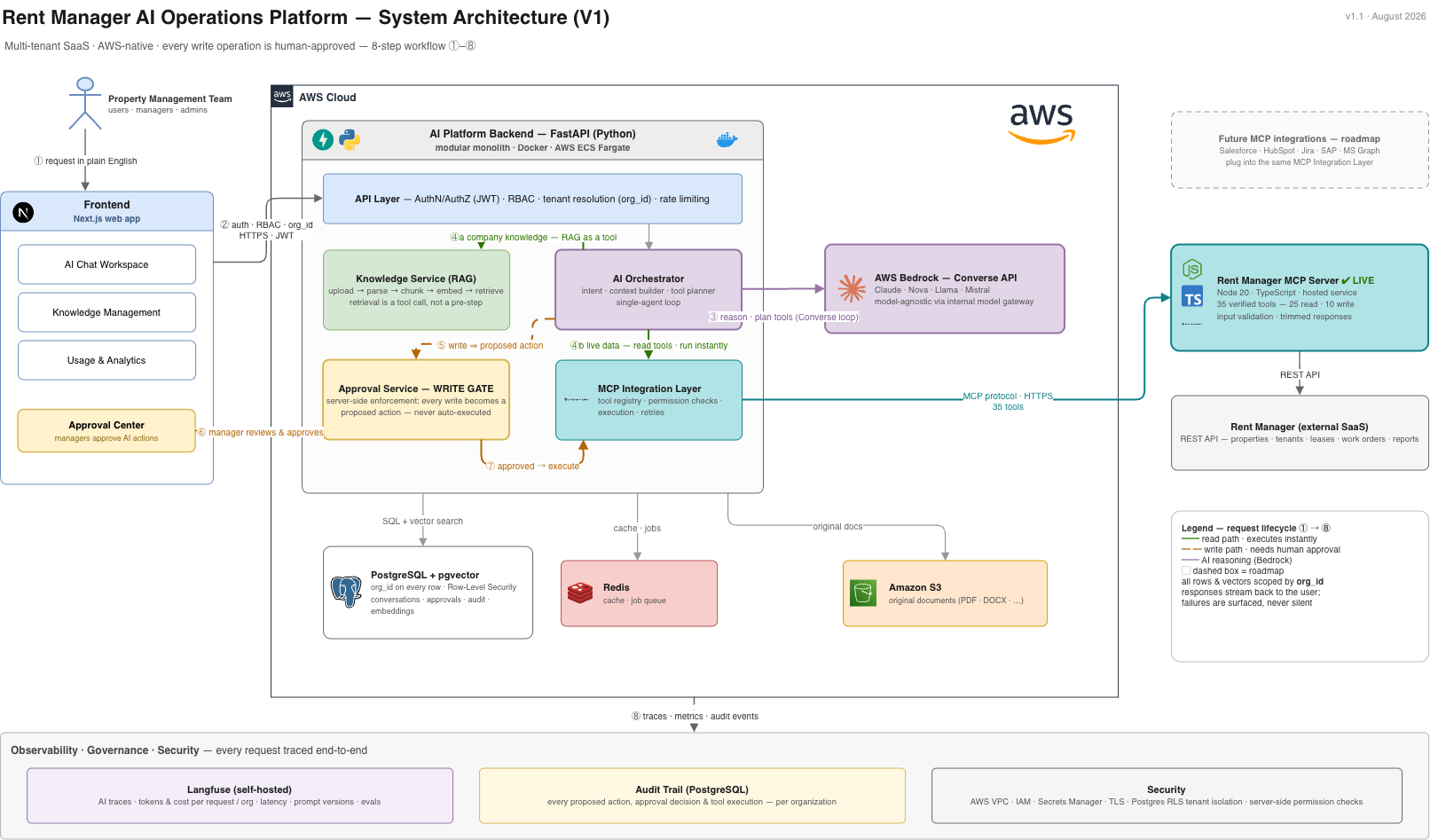
The architecture visual and product screens reproduce the supplied engagement materials. Screen names and values are illustrative product-design data, not measured client outcomes.
The system specification covers experience, application services, retrieval, model access, integration, security, observability, and cloud delivery.
Technology and platform names identify the specified solution, not partnerships or endorsements.
Bring one leasing, receivables, maintenance, tenant-service, or portfolio workflow. In 30 minutes, we’ll map the useful AI boundary, the approvals that matter, and a practical engineering next step.
30 minutes · Your workflow, control points, and next step
30 minutes · Your workflow, control points, and next step