Routing was tribal knowledge
Territories, priorities, and stock-aware failover lived inside a macro and the person who understood it.

RouteStock turns marketplace order files into stock-aware warehouse decisions, carton-level shipment records, and warehouse-ready outputs—without leaving critical logic inside one person’s spreadsheet.
Multi-warehouse routing.
Fulfillment execution.

Processed orders, configuration exceptions, stock gaps, and warehouse load stay visible.
Follow the workflow ↗Multi-warehouse fulfillment
Routing + allocation engine
Product & full-stack engineering
Which warehouse should ship it? Is stock truly available? How should it be packed? What file does the warehouse need?
In a multi-site network, every order line combines channel-specific data, ZIP territories, live availability, SKU conventions, packaging rules, and downstream formats. A spreadsheet macro can hide that complexity, but it cannot govern it.
RouteStock turns those decisions into explicit configuration, an explainable engine, and a daily workflow any authorized operator can run.
Territories, priorities, and stock-aware failover lived inside a macro and the person who understood it.
Concurrent order runs could compete for the same units without a reservation made at commitment.
Carton splits and per-warehouse file formats created repetitive work after allocation was complete.
Explore the supplied screens behind daily processing, inventory control, packaging configuration, and operational visibility.
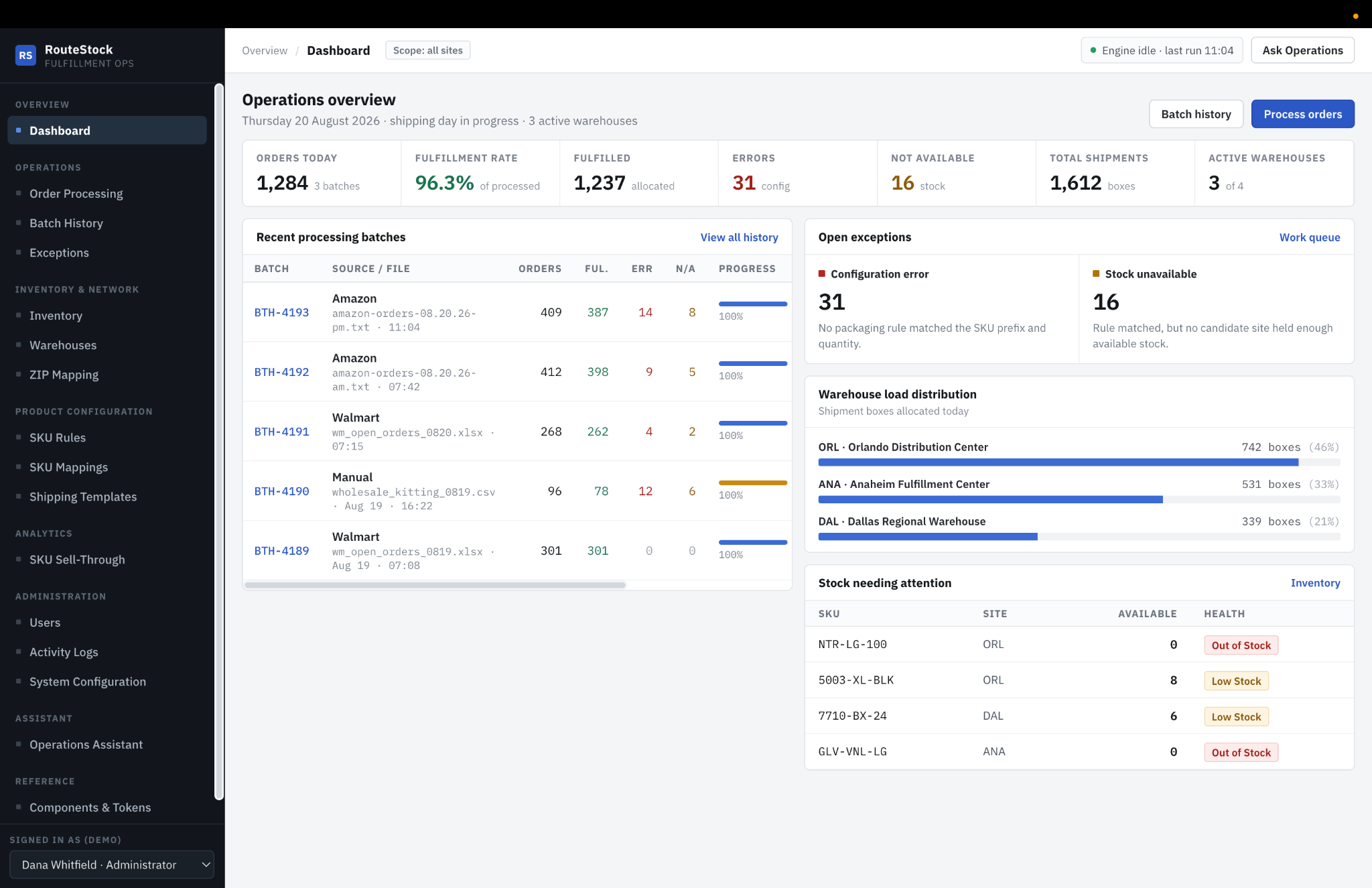
Recent batches, exceptions, warehouse load, and stock attention sit together so operations can see what moved and what needs intervention.
Import→Validate→Normalize→Route→Reserve→Cartonize→Export
The engine commits work only when configuration and stock support it. Every uncommitted line carries a specific reason, and a processed batch stays reversible only until warehouse files leave the system.
Look under the hood ↘Amazon TSV · Walmart XLSX/CSV · Manual template
Choose the strongest stocked site, reserve inventory, and emit physical boxes.
Name the missing packaging rule or unavailable stock—per order line.
Template-shaped XLSX or CSV, one file per destination site.
Undo releases commitments before export; after export, the interlock protects physical execution.
The stack separates operator experience, API authorization, business logic, and governed data—so a new channel or output format can be added without changing the fulfillment engine.

Permission-aware workflows make processing state, configuration, exceptions, and site scope visible.
Complex operational state stays predictable while long-running batches can report live progress.

Typed request and response contracts sit in front of 13 documented routers and a separate service layer.
Routing and allocation rules remain testable business logic rather than behavior buried in endpoints.

Network rules, inventory, orders, shipments, users, and audits share one transactional record.
Row locks prevent double-commitment, constraints protect history, and transactions keep a batch coherent.

Channel exports and configuration workbooks normalize into one model; stored templates shape warehouse output.
New downstream formats become configuration rather than changes to the allocation engine.

Role baselines, user overrides, and warehouse assignments are enforced on each relevant request.
Hiding an interface control is not a security boundary; refusing an unauthorized request is.

Versioned migrations evolve the schema while before/after records support attributable reversal.
A bad configuration edit or import can be restored without reconstructing values from memory.
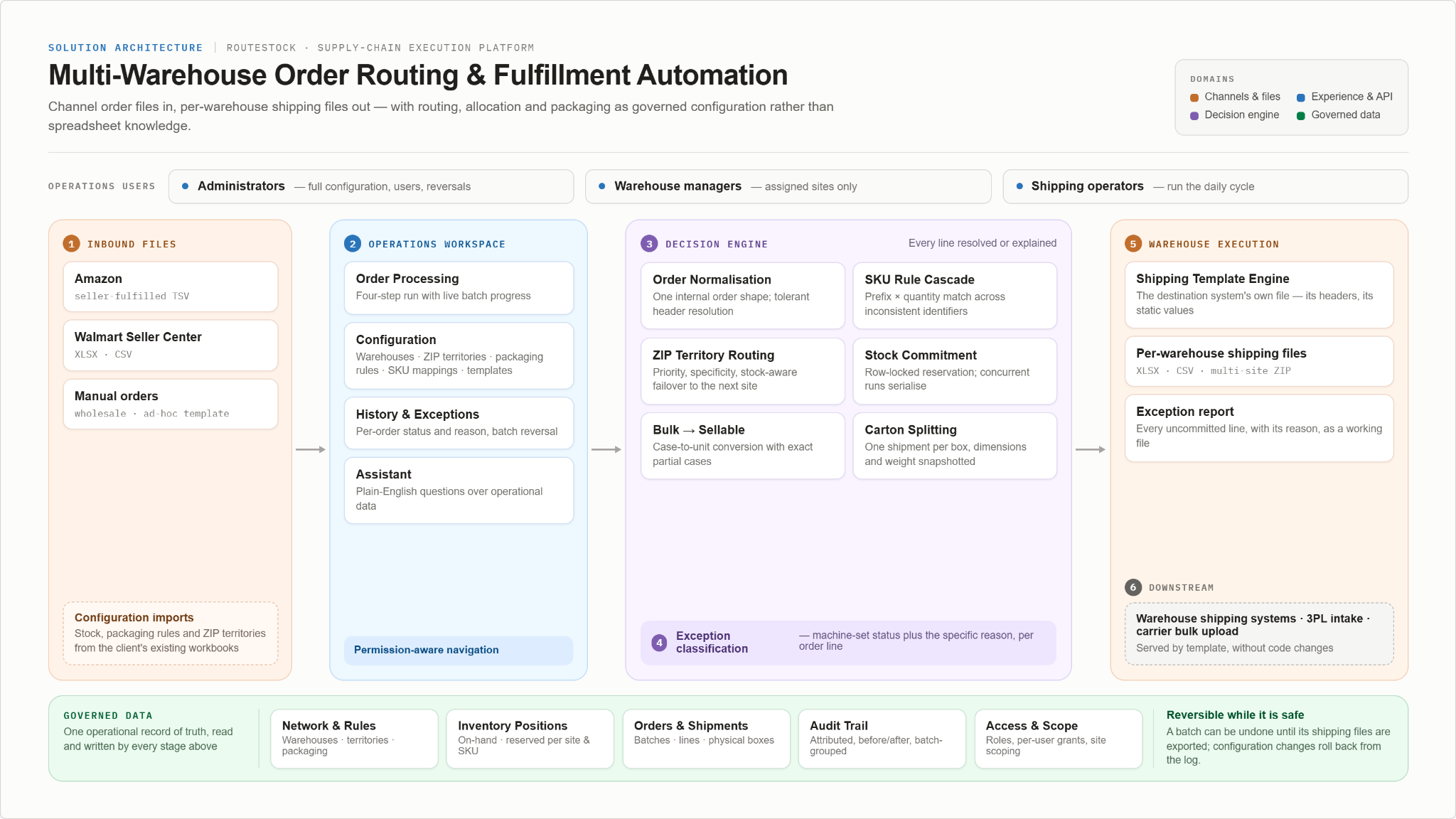
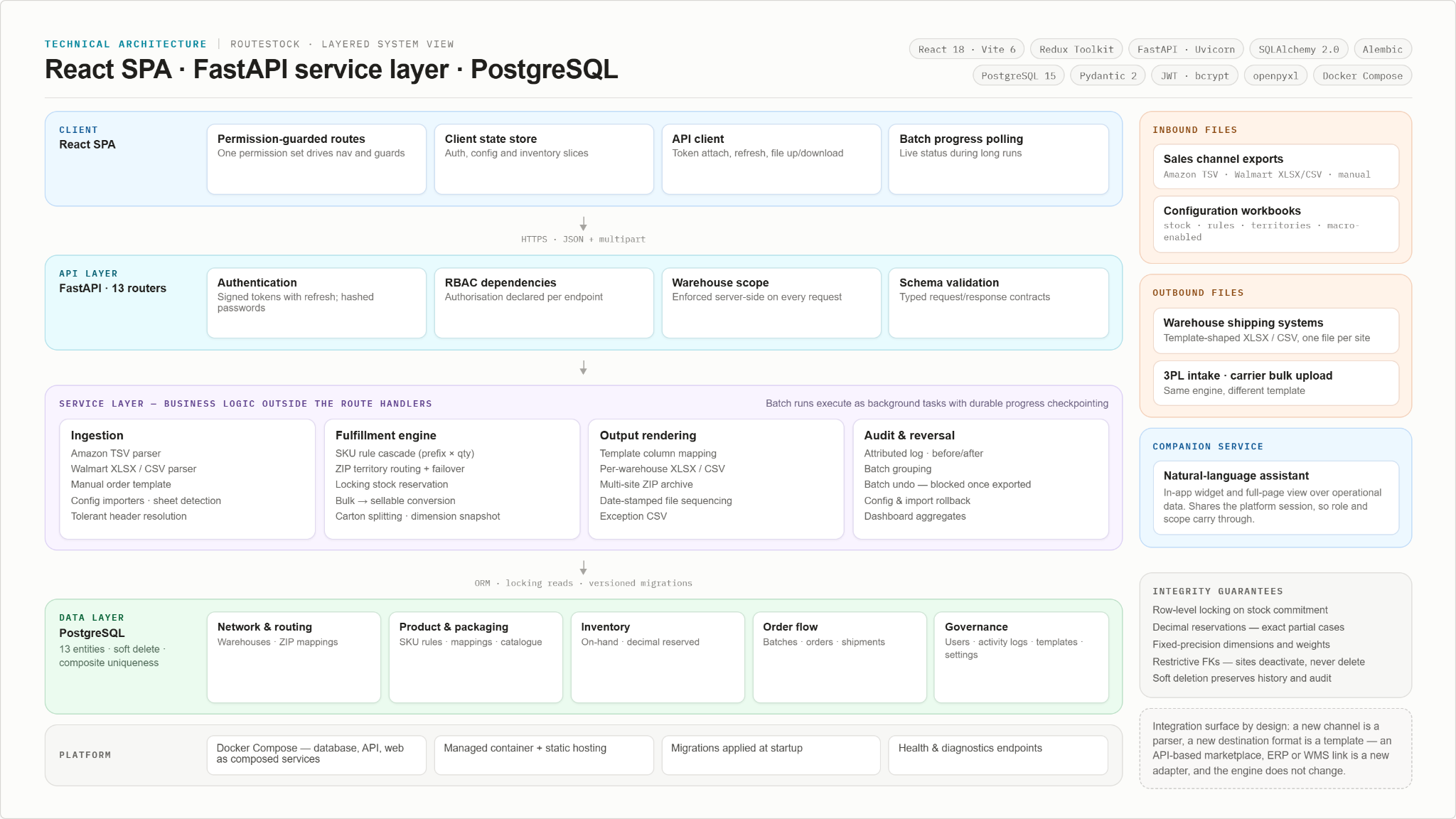
Architecture visuals reproduce the supplied project documentation. Demo screen values illustrate product behavior and are not presented as measured client outcomes.
The documented implementation covers the web client, API, business services, relational data, file handling, identity, and deployment.
Technology names identify the documented implementation, not partnerships or endorsements.
Bring one order-routing, inventory-allocation, or warehouse-output workflow. In 30 minutes, we’ll map the decision rules, operational risks, and a practical automation boundary.
30 minutes · Your operation, constraints, and next step
30 minutes · Your operation, constraints, and next step