Evidence is scattered across providers
Price, fundamentals, news, macro and sentiment live in different systems, so a single reasoning step never sees the whole picture.
A multi-agent trading platform that mirrors an institutional desk's structure — separate research, debate, risk and approval stages feeding a deterministic approval gate, so a trade proposal is never the output of a single model's opinion.
Adversarial research.
Deterministic approval.

Analyst team, research debate, order ticket and risk committee — each a distinct stage rather than one opinion.
Follow the pipeline ↗Investment research & execution
Multi-agent decision platform
Architecture & AI systems engineering
Financial decision-making depends on far more than price movement. Before responsibly taking a position, a team may need to evaluate historical price behaviour, technical indicators, fundamentals, news, macroeconomic conditions, sentiment, event probabilities, portfolio risk, position sizing, and previous decisions and their outcomes.
That information normally sits across different platforms and data providers.
More importantly, professional investment teams rarely rely on one person's view. Research is challenged, risk teams scrutinise the proposed exposure, and portfolio managers decide whether the trade should actually proceed. Traditional workflows achieve that through people and meetings.
Price, fundamentals, news, macro and sentiment live in different systems, so a single reasoning step never sees the whole picture.
A desk works by argument — a bull case and a bear case, bounded and compared — not by accepting the first thesis produced.
Approval has to be a deterministic gate that a proposal passes or fails, rather than a judgement the model makes about itself.
The delivered decision architecture.
From market evidence to an approved, machine-readable order.
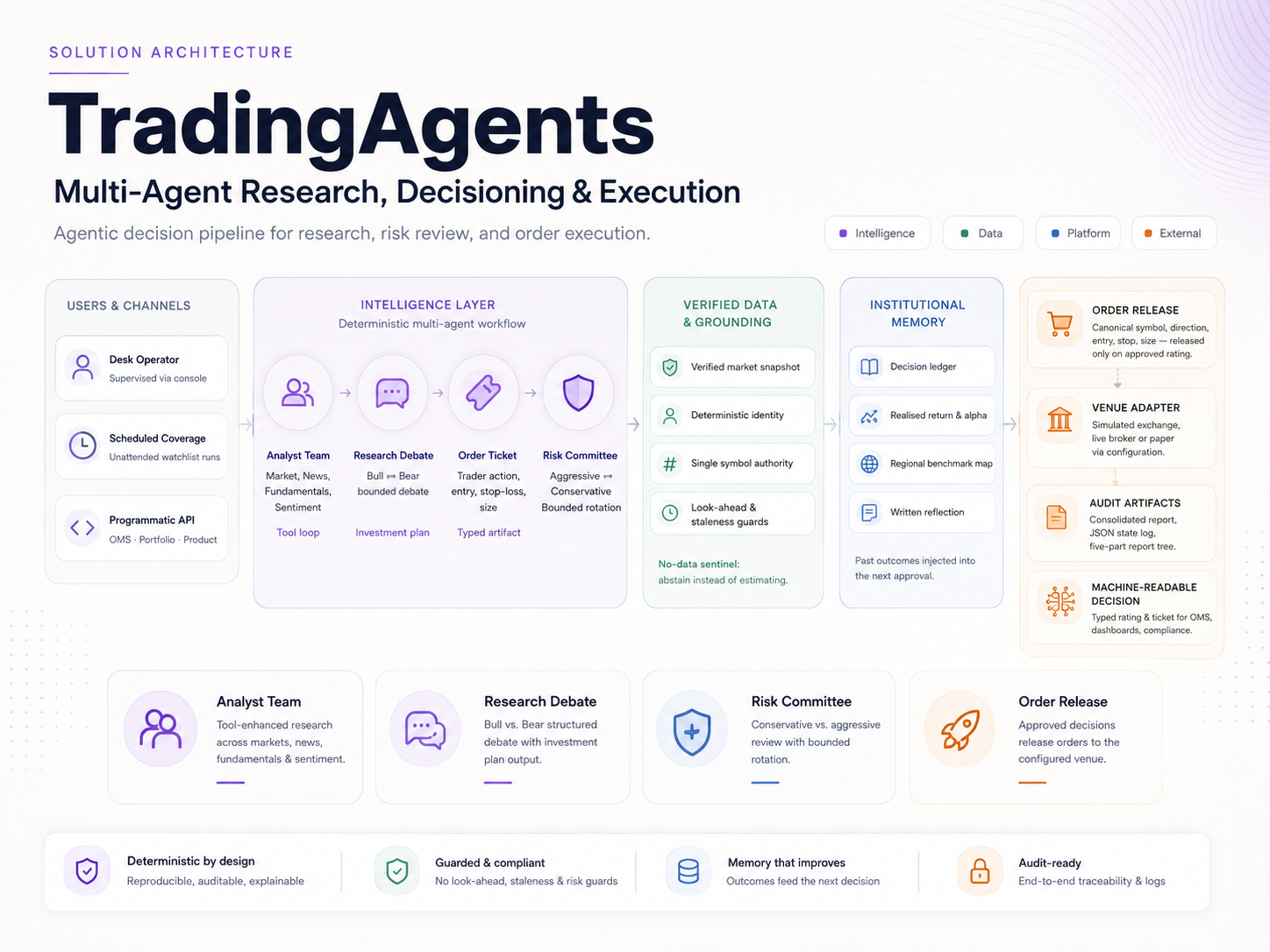
An analyst team gathers market, news, fundamentals and sentiment; a bounded bull-versus-bear debate follows; an order ticket is typed; a risk committee reviews it; and only an approved rating releases an order.
Analyst team→Research debate→Order ticket→Risk committee→Order release
Financial data is verified deterministically rather than accepted from a model. A no-data sentinel makes the system abstain instead of estimating, because an invented figure is worse than a missing one.
Past outcomes are injected into the next approval, so the desk's memory improves the decision rather than sitting in a report nobody reads.
Look under the hood ↘Market data, news, fundamentals and sentiment are collected, then checked against deterministic identity and staleness guards before any agent reasons over them.
Single-symbol authority, identity checks and look-ahead guards mean the agents reason over data that is actually current and correct.
The no-data sentinel stops the pipeline rather than allowing an estimate to stand in for a fact.
Bull and bear positions are argued to a bounded conclusion, producing an investment plan rather than a single unchallenged thesis.
A risk committee reviews the typed ticket in conservative-to-aggressive rotation, and only an approved rating releases an order to the configured venue.
The stack separates the parts that reason from the parts that verify and authorize, so the reproducible, auditable half of the system never depends on a model behaving well.

Runs the multi-stage workflow: analyst team, bounded research debate, order ticket and risk committee.
A desk is a sequence of distinct responsibilities; a graph makes each stage explicit rather than one long prompt.

Types the artifacts that move between stages, including the executable trade ticket itself.
An order that leaves the system has to be machine-readable and validated, not free text a model happened to produce.

Provide the reasoning behind analysis and debate, with the provider a configuration choice rather than an architectural one.
Reasoning quality varies by task and changes over time; the pipeline should not be rebuilt to change model.

Holds the decision ledger, realised return and alpha, benchmark comparison and written reflection.
Past outcomes are injected into the next approval, so the desk learns from what actually happened.

Carries fast-moving state across the pipeline stages during a decision cycle.
Working state and the permanent record have different lifetimes and different guarantees.

Packages the pipeline for reproducible runs, whether supervised by a desk operator or on scheduled coverage.
A decision process that cannot be re-run identically cannot really be audited.
The architecture diagram and narrative reproduce the supplied project documentation. This project's source material contains no product interface screens; the architecture diagram is shown in their place.
Technology names identify the documented implementation, not partnerships or endorsements.
Bring one decision your team makes repeatedly with AI assistance. In 30 minutes, we will map which stages need argument, which need verification, and where approval has to be deterministic.
30 minutes · Your process, data and constraints