





Each order goes out once.
Each order has a unique ID. After a timeout, the system finds out what the broker did before it tries again. A timeout can no longer make a second order.
Cadence case study ↗
Your strategy decides what to trade. We build the safety around it. Every order passes checks first. One decision makes one order. Your records match your broker. We have built seven trading systems, from options desks to AI research agents.
Seven systems, each with a published case study: the screens, the rules and the stack.

Runs a trading operation with 24 pre-trade checks, broker reconciliation and a live command center.
Algorithmic trading operationsRead the case study ↗
Turns one options decision into the right order on every broker account.
Algorithmic options tradingRead the case study ↗
Copies a master trader’s orders to funded accounts in real time, once each.
Proprietary futures tradingRead the case study ↗
AI agents research and debate a trade. A risk committee decides if it goes out.
Investment research & executionRead the case study ↗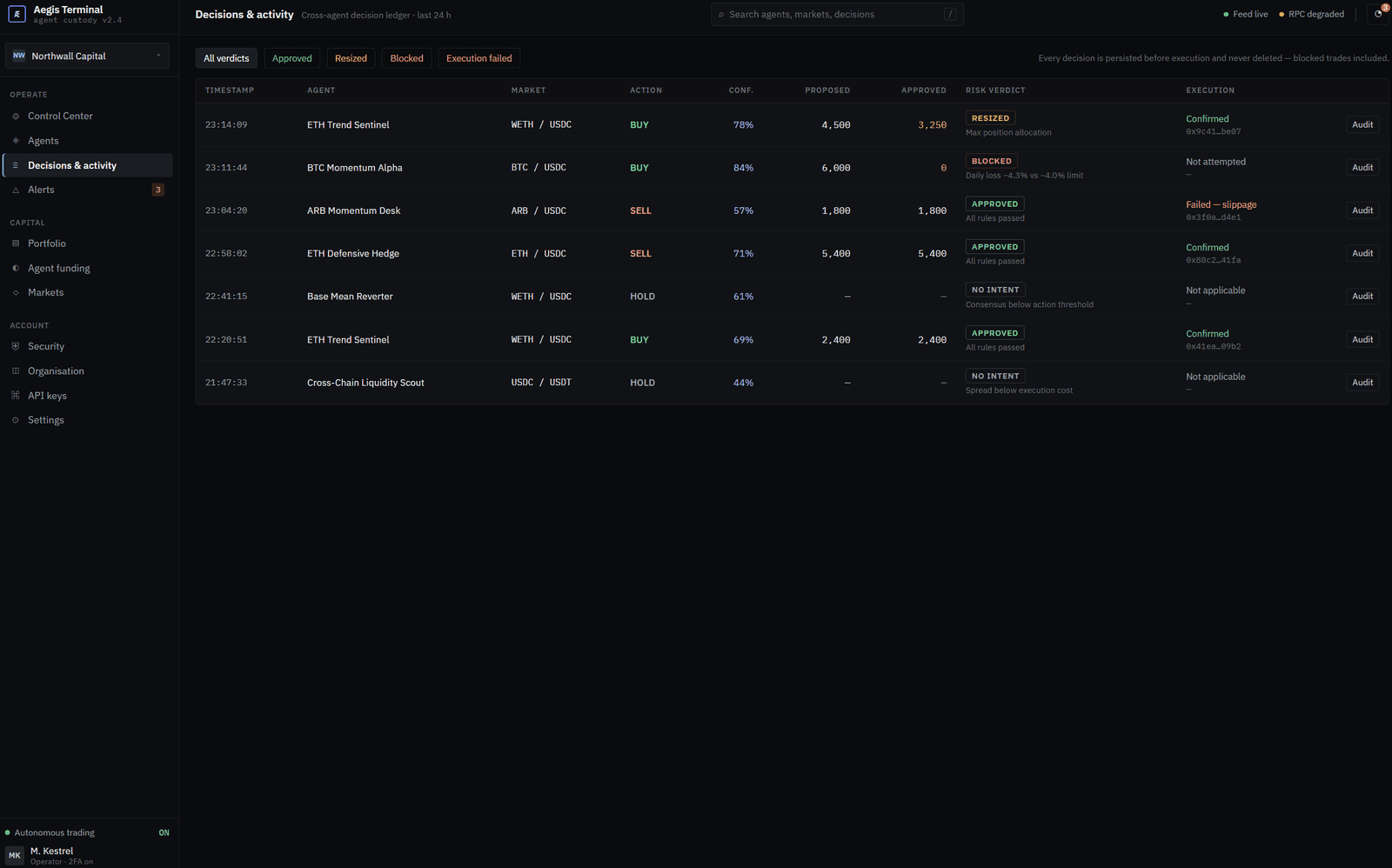
AI agents propose crypto trades. Risk rules written in code decide which ones are allowed.
Digital asset tradingRead the case study ↗
A trading terminal with order-book speed, and custody kept on the blockchain.
Web3 / DeFi tradingRead the case study ↗
Trades short prediction-market candles automatically, with sizing and drawdown controls.
Prediction-market tradingRead the case study ↗A good strategy still loses money when order handling fails. These four controls guard that part.
Each order has a unique ID. After a timeout, the system finds out what the broker did before it tries again. A timeout can no longer make a second order.
Cadence case study ↗Algo Trade turns one decision into the right order for each account. Each account keeps its own broker, size multiplier and capital. Trade Copier copies a master account to funded accounts, with stops and targets.
Algo Trade case study ↗In Quant and Trading Agents, the AI only proposes a trade. Risk rules written in code, or a risk committee, decide if it goes out. A rejected trade stays rejected.
TradingAgents case study ↗After a restart or a lost connection, the system asks the broker what is real and continues from there. Cadence compares the live transaction stream with a separate check.
Cadence case study ↗Not sure yet? These answers settle most of it.
Each order has a unique ID. If the broker does not answer, the system finds out what happened before it tries again. Trade Copier also merges repeated platform events into one trade. So one decision makes one order on each account.
No. In our builds the AI does not place orders by itself. In Trading Agents, a risk committee reviews each ticket, and only an approved rating sends an order. In Quant, risk rules in code set position limits. In Cadence, research can suggest a strategy change, but a person approves it.
Algo Trade works with several broker accounts through Kite Connect and SmartConnect. Cadence connects to OANDA. For another broker, we first read its API and check what it allows. Bring your list of brokers to the call and we check it with you.
We do not publish a fixed price. The scope sets it: how many brokers, strategies and risk rules you need, and if you need research tools. In the free 30-minute call we look at your workflow and agree a next step.
We build audit trails, risk limits and approval gates that your compliance team can check. We do not give legal advice and we do not approve compliance. Rules differ by market, so your compliance team or lawyer decides what your product must meet.
Bring one execution, risk or reconciliation workflow. In 30 minutes we map the failure modes and the control points.